
Truck Collision / Accident Attorney: Complete Guide to Truck Accident Claims in the United States
A serious truck collision can change a person’s life in seconds. Victims may suffer catastrophic injuries, face expensive medical treatment, lose their ability to work, or experience the tragic loss of a family member. Unlike ordinary car accidents, collisions involving commercial trucks often involve complicated insurance policies, federal safety regulations, multiple potentially responsible parties, and extensive accident investigations.
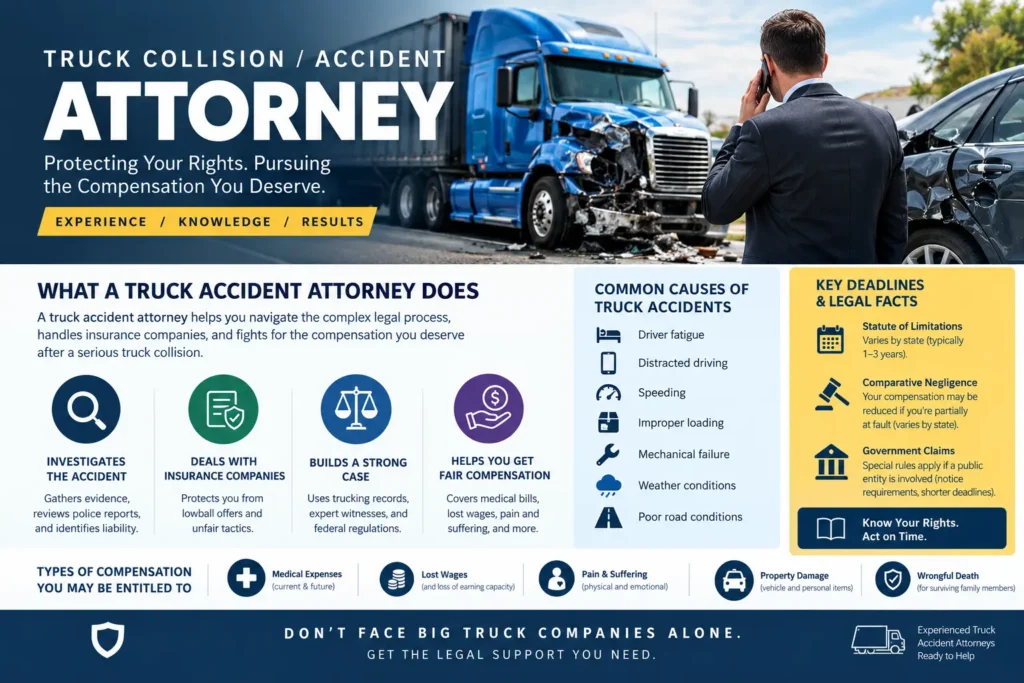
A truck accident attorney helps injured victims and their families understand their legal rights, investigate the collision, identify who may be responsible, calculate their losses, negotiate with insurance companies, and pursue compensation through a settlement or lawsuit when appropriate.
In the United States, truck accident claims may involve tractor-trailers, 18-wheelers, semi-trucks, delivery trucks, dump trucks, tanker trucks, box trucks, and other commercial vehicles. The legal process depends on the circumstances of the crash, the applicable state laws, the injuries involved, and the evidence available.
This comprehensive guide explains what to do after a truck accident, when to hire an attorney, how liability is determined, what compensation may be available, how insurance claims work, and how to choose the right truck accident lawyer.
What Is a Truck Accident Attorney?
A truck accident attorney is a personal injury lawyer who represents individuals or families seeking compensation after a collision involving a commercial truck or other large vehicle.
These attorneys investigate the circumstances of the accident, gather evidence, evaluate injuries and financial losses, identify potentially liable parties, and handle communications and negotiations with insurers.
Truck accident attorneys may assist with claims involving:
A truck accident attorney’s role is not simply to file paperwork. A thorough investigation may reveal that responsibility extends beyond the driver to a trucking company, maintenance provider, cargo-loading company, vehicle manufacturer, or another party.
Whether any of these parties is legally responsible depends on the evidence and applicable law.
Why Are Truck Accident Cases More Complicated Than Car Accidents?
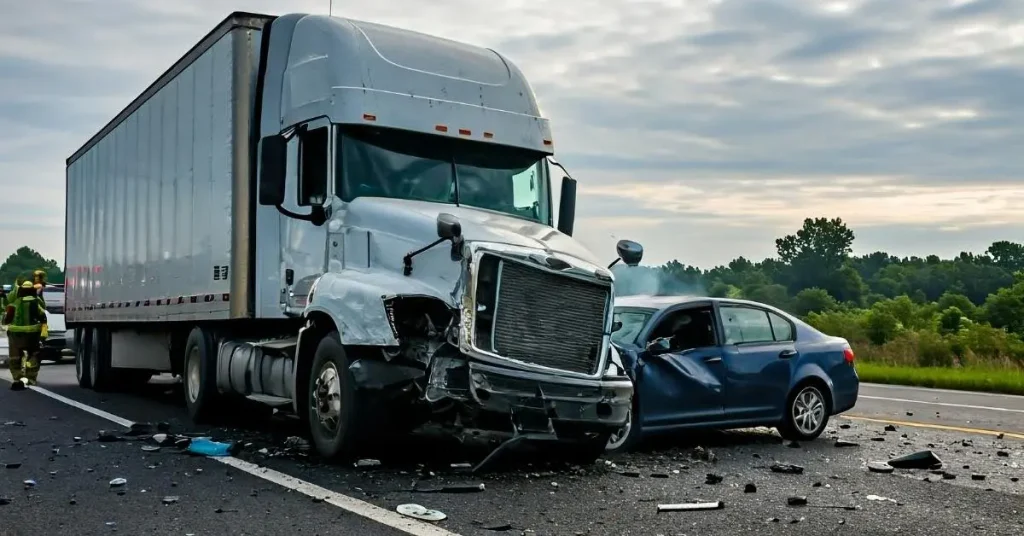
Commercial truck accidents can involve more complex legal and technical issues than typical passenger-vehicle collisions.
Multiple parties may be responsible
A truck driver may have caused a crash through careless driving, but the trucking company may also have contributed through unsafe scheduling, inadequate training, or negligent maintenance.
Other possible defendants include freight brokers, cargo-loading contractors, maintenance companies, and manufacturers of defective components.
Federal trucking regulations may apply
The Federal Motor Carrier Safety Administration (FMCSA) establishes safety regulations for many commercial motor vehicles and motor carriers. Depending on the operation, relevant requirements may concern driver qualifications, hours of service, vehicle inspections, maintenance, and cargo securement.
Evidence of a regulatory violation may help establish negligence, although its legal significance depends on the applicable law and facts.
Commercial insurance can be complicated
Commercial trucking operations may involve liability policies, excess coverage, and other insurance arrangements. Determining which policies apply, who qualifies as an insured, and what limits are available can require detailed investigation.
Important evidence may be controlled by businesses
Electronic logging device records, dispatch communications, maintenance histories, onboard camera footage, and vehicle data may be held by trucking companies or other commercial entities.
Some evidence may be overwritten, routinely discarded, or lost unless it is preserved promptly.
Injuries may have long-term consequences
The force involved in a large-truck collision can cause traumatic brain injuries, spinal cord damage, fractures, internal injuries, and permanent disabilities. Evaluating a claim may require medical experts, life-care planners, vocational specialists, or economists.
These factors make early evidence preservation and a careful assessment of damages especially important.
Truck Accident Statistics in the United States
Truck crashes remain an important road-safety concern throughout the United States.
According to the National Highway Traffic Safety Administration’s Traffic Safety Facts: 2023 Data — Large Trucks, an estimated 528,177 large trucks were involved in police-reported traffic crashes in 2023. Those crashes resulted in an estimated 5,472 deaths and 153,452 injuries. These figures describe crashes involving large trucks, not necessarily crashes caused by truck drivers.
Source: NHTSA, Large Trucks: 2023 Data.
The FMCSA also publishes annual Large Truck and Bus Crash Facts reports that analyze fatal, injury, and property-damage-only crashes. Its official crash-facts resource is useful for reviewing national trends and understanding the risks associated with commercial transportation.
Statistics alone do not determine fault in an individual case. Every collision must be evaluated using its specific evidence, road conditions, vehicle information, and applicable legal standards.
What Should You Do After a Truck Accident?
The steps you take immediately after a truck accident may protect your health and help preserve evidence for a future insurance claim or lawsuit.
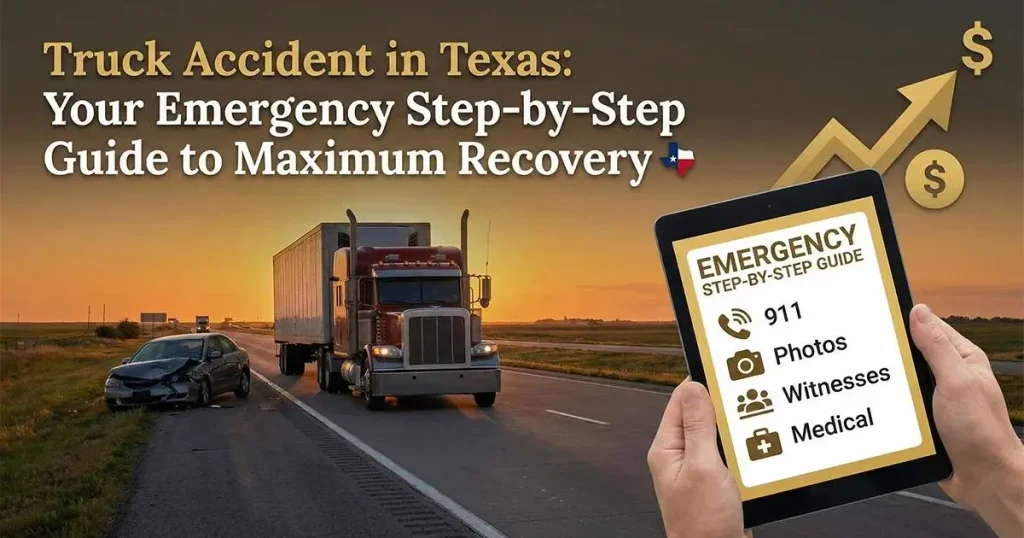
Step 1: Seek emergency medical attention
Call 911 if anyone is seriously injured, trapped, or in immediate danger. Follow emergency responders’ instructions and seek medical evaluation as soon as possible.
Some injuries, including concussions, internal bleeding, and certain spinal injuries, may not be immediately apparent.
Keep copies of medical records, discharge instructions, prescriptions, diagnostic results, and follow-up recommendations.
Step 2: Report the accident
Notify law enforcement and cooperate with the investigation. Obtain the police report number and ask how you can access the report when it becomes available.
Provide accurate information, and avoid guessing about details you do not know.
Step 3: Document the accident scene if it is safe
If you can do so without risking further injury, collect photographs or videos of:
Do not enter traffic or approach hazardous cargo to collect evidence.
Step 4: Exchange information
Obtain the other driver’s name, contact information, license details, insurance information, and relevant commercial vehicle or employer information.
If the truck displays a motor carrier identification number or USDOT number, record it when safe.
Step 5: Preserve relevant records
Keep medical bills, repair estimates, towing receipts, wage statements, correspondence, and records of expenses related to the collision.
Avoid repairing or disposing of a seriously damaged vehicle before documenting its condition and considering whether it may need to be inspected.
Step 6: Be careful when speaking with insurance companies
Notify your own insurer as required by your policy. You may also need to communicate with another insurer.
Provide truthful basic facts, but be cautious about recorded statements, broad medical authorizations, or requests to sign settlement documents before understanding their implications.
You generally should not speculate about fault or minimize symptoms that you are experiencing.
Step 7: Consider contacting a truck accident attorney
An attorney may help preserve evidence, identify potential defendants, assess available insurance coverage, and explain the deadlines that apply to your claim.
You do not necessarily need to wait until treatment is complete to seek legal advice.
When Should You Hire a Truck Accident Attorney?
Consider consulting a truck accident attorney if:
For minor crashes involving only property damage, hiring a lawyer may not always be necessary. The decision depends on the complexity of the dispute, the available insurance, and the potential losses.
An initial consultation can help you understand whether legal representation is worthwhile.
Who Can Be Held Liable in a Truck Accident?
Determining liability is one of the most important parts of a commercial truck accident case. More than one person or business may share responsibility.
The truck driver
A truck driver may be liable if negligent conduct contributed to the collision. Examples include:
The evidence must establish the relevant legal elements of liability under the governing law.
The trucking company
A motor carrier may be responsible for its own negligence or, under applicable legal principles, for conduct by its employee acting within the scope of employment.
Potential issues include:
The company’s responsibility is not automatic simply because its truck was involved in the accident.
The cargo-loading company
Improper cargo loading can contribute to a truck becoming unstable, tipping over, or losing cargo on the road.
A loading contractor or another responsible party may face liability if negligent loading, weight distribution, or cargo securement contributed to the crash.
The truck or component manufacturer
A defective brake system, tire, steering component, coupling device, or other vehicle part may contribute to an accident.
Depending on the evidence and applicable product-liability law, a manufacturer or another entity in the distribution chain may be responsible.
The maintenance or repair company
A third-party repair provider may be liable if negligent work or failure to identify a dangerous defect contributed to the collision.
Other drivers or road-related parties
Another motorist’s actions, a contractor’s unsafe work zone, or a dangerous road condition may contribute to a truck crash. A government entity could potentially be involved in some cases, but claims against public bodies often have special notice requirements and shorter deadlines.
An attorney investigates these possibilities to determine which claims have factual and legal support.
Common Types of Truck Collisions
Understanding the type of accident can help identify the evidence that needs to be investigated.
Rear-end truck accidents
A truck may strike a vehicle ahead when the driver follows too closely, fails to brake in time, or travels too fast for traffic conditions. Investigators may examine stopping distance, road friction, brake condition, and vehicle data.
Jackknife accidents
A jackknife occurs when a truck’s tractor and trailer rotate sharply relative to each other. Braking, traction loss, road conditions, and driving decisions may be relevant.
Rollover accidents
A truck may roll over because of excessive speed on a curve, unstable cargo, abrupt steering, or other contributing factors.
Underride accidents
An underride collision can occur when a passenger vehicle slides beneath a truck or trailer. These crashes may result in severe injuries or fatalities.
Blind-spot collisions
Large trucks have areas around them where visibility can be limited. Unsafe lane changes, inadequate observation, or poor vehicle positioning may contribute to a collision.
Tire blowout accidents
A tire failure can cause a driver to lose control or leave debris on the roadway. Relevant evidence may include tire condition, maintenance records, loading, manufacturing defects, and road hazards.
Wide-turn accidents
Commercial trucks often need additional space to turn. A collision may occur when the driver misjudges clearance, fails to check surrounding traffic, or makes an unsafe maneuver.
Cargo-related accidents
Unsecured or shifting cargo can destabilize a vehicle or fall onto other road users. The investigation may focus on loading procedures, tie-downs, weight distribution, and applicable cargo-securement rules.
How Is Fault Proven in a Truck Accident Case?
A successful claim generally requires evidence establishing the elements of negligence or another applicable legal theory. The precise standard varies by jurisdiction and claim type.
A truck accident attorney may investigate the following evidence.
Police reports: These can identify involved parties, witness statements, road conditions, and an officer’s preliminary observations. A police report is important evidence, but it does not necessarily settle every issue of civil liability.
Photographs and video: Images from the scene, nearby businesses, traffic cameras, or vehicle cameras may help reconstruct the collision.
Electronic logging device (ELD) records: ELDs record driving time for drivers subject to the applicable requirements. Such records may help investigators evaluate possible hours-of-service issues. FMCSA explains the ELD rules and applicable exceptions in its official ELD guidance.
Vehicle event data: Depending on the truck’s equipment, available data may include speed, braking, acceleration, or other information around the collision.
Maintenance and inspection records: These may help determine whether a mechanical defect was known, should have been identified, or was negligently repaired.
Driver qualification and training records: These may be relevant when a claim concerns hiring, training, supervision, or driver qualifications.
Dispatch and communication records: Messages, schedules, delivery deadlines, and other communications may help establish what the driver or carrier knew and when.
Witness testimony: Independent witnesses may clarify vehicle movements, traffic conditions, and events immediately before impact.
Expert analysis: Accident reconstruction specialists, engineers, medical experts, and other qualified professionals may assist when technical questions are disputed.
Why is evidence preservation important?
Some records may be subject to routine deletion or limited retention periods. Promptly identifying and preserving relevant evidence can be crucial.
An attorney may send a preservation letter, sometimes called a spoliation or litigation-hold letter, requesting that potentially relevant records and physical evidence not be destroyed.
A preservation letter does not guarantee that every item will be available, but it can help document the request and clarify which materials may be relevant.
What Compensation Can You Recover After a Truck Accident?
The amount and type of compensation available depend on the injuries, financial losses, liability evidence, insurance coverage, and applicable state law.
Potential categories of damages include the following.
Medical expenses
Recoverable medical losses may include reasonable and legally compensable costs for:
Lost wages
If injuries prevent you from working, you may be able to claim income lost because of the accident.
Documentation may include pay stubs, employer statements, tax records, and medical evidence supporting work restrictions.
Reduced future earning capacity
Some injuries prevent victims from returning to their previous jobs or reduce their ability to earn income in the future.
A claim may require medical opinions, vocational assessments, and economic analysis.
Pain and suffering
Where allowed, non-economic damages may compensate for physical pain, emotional distress, and the effects of an injury on daily life.
The legal rules and methods used to evaluate these losses differ by state.
Emotional distress
Depending on the circumstances and applicable law, damages may be available for psychological effects such as anxiety, trauma-related symptoms, or emotional suffering associated with the accident.
Disability and loss of normal activities
A serious injury may limit mobility, independence, hobbies, household activities, and relationships. These effects may be relevant to non-economic damages.
Property damage
A claim may include legally recoverable vehicle repair or replacement costs and damage to other personal property.
Wrongful death damages
When a truck accident causes a death, eligible family members or the estate may pursue certain damages under the applicable wrongful death or survival statutes.
Depending on state law, these may include funeral expenses, lost financial support, loss of companionship, or other legally recognized losses.
Punitive damages
In some jurisdictions, punitive damages may be available in exceptional cases involving conduct that meets a heightened legal standard, such as certain forms of intentional misconduct or extreme recklessness. They are not available in every case and should not be assumed.
How Much Is a Truck Accident Claim Worth?
There is no reliable universal average that can predict the value of an individual truck accident claim.
Two crashes involving similar vehicles may result in very different outcomes because the victims’ injuries, medical needs, lost income, liability evidence, and applicable laws differ.
Factors that may influence claim value include:
An attorney may estimate a reasonable range after reviewing the medical evidence, financial documentation, liability issues, and available coverage. Any estimate remains uncertain until the facts and applicable law are sufficiently understood.
Does the insurance policy limit determine the claim’s value?
Not necessarily. The value of legally recoverable damages and the amount that can practically be collected are separate questions.
Available coverage may affect recovery, but a policy limit is not automatically the value of a claim. Other insurance, additional liable parties, or collectible assets may sometimes be relevant, subject to the facts and law.
How Does the Truck Accident Claim Process Work?
Although every case is different, a truck accident claim often follows these stages.
Stage 1: Initial consultation
The attorney reviews the collision, injuries, available documents, and potential legal issues.
Stage 2: Investigation
The legal team collects evidence, identifies potential defendants, examines insurance arrangements, and evaluates the likely causes of the crash.
Stage 3: Medical treatment and damages assessment
The claimant receives appropriate medical care while the legal team documents the injuries and financial consequences. Depending on the case, future medical needs may need to be assessed before a final settlement is considered.
Stage 4: Insurance claims and negotiations
The attorney may submit a demand supported by liability evidence, medical records, wage documentation, and other proof of damages.
The insurer may investigate, request additional information, dispute responsibility, or make a settlement offer.
Stage 5: Filing a lawsuit if appropriate
If negotiations do not produce an acceptable resolution, the claimant may file a lawsuit before the applicable deadline.
Filing a lawsuit does not guarantee a trial. Cases may resolve through negotiations, mediation, or other settlement processes.
Stage 6: Discovery and expert evaluation
The parties may exchange documents, take depositions, obtain expert opinions, and investigate disputed issues.
Stage 7: Settlement or trial
If the case settles, the parties document the agreement and address payment, liens, and other required matters. If the case proceeds to trial, the fact-finder evaluates the evidence and applicable law.
The duration varies considerably. Some claims resolve relatively quickly, while complex cases involving serious injuries, disputed liability, or multiple defendants may take much longer.
What Should You Know About Truck Accident Insurance Claims?
Commercial truck accident claims may involve multiple insurers and complicated questions about coverage.
Commercial trucking insurance
Commercial carriers may maintain motor vehicle liability coverage, excess coverage, or other policies depending on their operations and legal obligations.
The applicable requirements can depend on factors such as the vehicle, cargo, type of transportation, and whether the operation is subject to federal or state regulation.
The trucking company’s insurer
An insurer representing a trucking company may investigate the accident and seek information from involved parties. Its interests may differ from those of an injured claimant.
A settlement offer should be evaluated against the evidence, medical prognosis, financial losses, and legal risks.
Your own insurance
Depending on your state and policy, personal auto insurance may provide benefits such as personal injury protection, medical payments coverage, uninsured motorist coverage, or underinsured motorist coverage.
These coverages are not available in the same form in every state, and eligibility depends on the policy and circumstances.
Should you accept the first settlement offer?
Not without understanding what it covers and what rights you would give up.
A settlement release may prevent you from pursuing additional compensation for the same claim, even if further medical expenses or complications arise later.
Before accepting a settlement, consider whether:
A lawyer can explain the advantages and disadvantages of settling at a particular stage.
What Is the Statute of Limitations for a Truck Accident Lawsuit?
The statute of limitations is the legal deadline for filing a lawsuit. Missing the applicable deadline can result in losing the right to pursue a claim, subject to limited exceptions under the relevant law.
There is no single statute of limitations that applies to every truck accident case across the United States.
The deadline depends on the state and the type of claim. Personal injury, wrongful death, property damage, and claims involving government entities may have different rules.
Additional complications may arise when the injured person is a minor, the defendant is a public entity, or a legal rule affects when the deadline begins.
Federal law may also apply to certain issues, but the involvement of a commercial truck does not automatically mean that a federal court or federal statute of limitations governs the entire personal injury claim.
Because some claims require action much earlier than others, it is important to identify the correct deadline promptly.
For a starting point, see Nolo’s state-by-state truck accident statute of limitations guide. Confirm the current rules with a qualified attorney in the relevant state.
What Happens If You Were Partly at Fault?
You may still be able to recover compensation if you contributed to a truck accident, depending on the state’s comparative or contributory negligence rules.
States use different approaches:
For example, suppose a claimant has $100,000 in otherwise recoverable damages and is found 20% responsible. Under a pure comparative negligence system, the damages would generally be reduced to $80,000 before considering other applicable adjustments.
This is an illustration, not a prediction of an actual case outcome. State-specific rules, damage limitations, and other factors may change the result.
Do not assume that you have no claim simply because an insurer alleges that you were partly responsible.
What If a Truck Accident Causes a Death?
A fatal truck collision can create devastating financial and emotional consequences for surviving family members.
Depending on state law, an eligible representative or beneficiary may be able to bring a wrongful death claim or a related survival action.
Potentially recoverable losses may include:
Who may file, which damages are available, and how any recovery is distributed vary by state.
Families should also be aware that claims involving government defendants or other special circumstances may have unusually short notice or filing deadlines.
A wrongful death attorney can explain who is eligible to bring a claim and what evidence is needed to establish liability and damages.
How Much Does a Truck Accident Attorney Cost?
Many personal injury attorneys handle truck accident cases under a contingency fee agreement. Under this arrangement, the attorney’s fee is generally calculated as an agreed percentage of a recovery rather than charged as a standard hourly fee.
However, fee percentages and expense arrangements vary. A contingency agreement does not necessarily mean the client will owe nothing if there is no recovery; responsibility for case costs and other expenses depends on the written agreement and applicable rules.
Before hiring an attorney, ask:
Request a written agreement and make sure you understand the terms before signing.
How to Choose the Best Truck Accident Attorney in the USA
Choosing the right attorney can affect how effectively your case is investigated and presented.
Look for relevant truck accident experience
Ask whether the lawyer regularly handles commercial vehicle claims, including cases involving severe injuries, disputed liability, and multiple defendants.
Evaluate investigation capabilities
Complex truck cases may require accident reconstruction experts, vehicle inspections, electronic data analysis, and detailed review of carrier records.
Ask how the firm investigates these issues and whether it has access to appropriate specialists.
Understand who will handle your case
Clarify whether the attorney you meet will personally manage the case or whether much of the work will be delegated to other lawyers or staff.
Ask about communication
Find out how often the firm provides updates, who will answer questions, and how urgent decisions are handled.
5. Review the fee agreement
Make sure the contingency percentage, litigation costs, and expense responsibilities are clearly explained in writing.
Ask about case strategy
A good attorney should be able to explain the major legal issues, evidence needed, potential obstacles, and possible paths to resolution without guaranteeing a particular outcome.
Check professional standing
Confirm the lawyer’s licensing status and review any relevant public disciplinary information through the appropriate state bar authority.
Be cautious of unrealistic promises
No attorney can ethically guarantee a specific settlement or verdict. Statements promising a certain payout without investigating the case should be treated carefully.
Questions to Ask a Truck Accident Lawyer During Your First Consultation
Prepare a few questions before your initial meeting:
Bring the police report if available, photographs, insurance information, medical records, and a summary of missed work or other expenses. Do not delay urgent legal consultation simply because you do not yet have every document.
Frequently Asked Questions About Truck Accident Attorneys
What does a truck accident attorney do?
A truck accident attorney investigates a collision, evaluates potential liability, preserves evidence, calculates legally recoverable damages, communicates with insurers, negotiates settlements, and files or litigates a lawsuit when appropriate.
When should I contact a truck accident lawyer?
Contact a lawyer as soon as reasonably possible if you have significant injuries, disputed fault, a complicated commercial vehicle crash, or concerns about evidence or deadlines. Early advice may help preserve important information.
How much does a truck accident lawyer cost?
Many truck accident lawyers use contingency fees, meaning their fee is generally tied to the recovery. The percentage, litigation expenses, and responsibility for costs vary by agreement, so review the written contract carefully.
How much compensation can I receive after a truck accident?
Compensation depends on medical expenses, lost income, future care, pain and suffering where recoverable, the strength of the liability evidence, insurance coverage, and state law. No attorney can reliably determine the exact value without evaluating the case.
Who is responsible for a commercial truck accident?
Potentially responsible parties include the driver, trucking company, cargo loader, maintenance provider, manufacturer, or another road user. Liability depends on evidence establishing the applicable legal requirements.
Can I sue a trucking company after an accident?
Potentially, yes. A trucking company may be liable for its own negligence or for an employee’s conduct under applicable legal principles. A claim requires facts supporting a valid legal basis for liability.
What if the truck driver was not employed directly by the trucking company?
Independent contractor arrangements do not automatically eliminate liability. The actual relationships, degree of control, statutory rules, insurance arrangements, and other relevant facts must be examined.
What if the truck driver has no personal insurance?
Commercial trucking operations may be covered by commercial insurance rather than an individual driver’s personal auto policy. An investigation can identify applicable policies and potential additional sources of recovery.
How long does a truck accident claim take?
The timeline depends on injury severity, treatment, disputed facts, the number of defendants, insurance negotiations, court schedules, and whether the case proceeds to trial. Some claims settle in months; others take considerably longer.
Can I file a claim if I did not go to the hospital immediately?
A delay in seeking medical care does not automatically eliminate a claim. However, insurers may question whether particular injuries were caused by the collision. Seek appropriate medical care and explain your symptoms and the timing accurately.
What if the insurance company denies my claim?
A denial is not necessarily the final word. Review the stated reasons, preserve supporting evidence, and consider obtaining legal advice. Depending on the circumstances, additional documentation, negotiation, an insurance dispute process, or litigation may be appropriate.
Can I recover compensation if I was partially responsible?
Possibly. The answer depends on the state’s negligence rules and the degree of responsibility assigned to each party. Some states reduce recovery proportionately, while others impose thresholds or stricter restrictions.
Is a truck accident claim different from a car accident claim?
Yes, it can be. Truck claims may involve commercial insurance, federal safety regulations, electronic driving records, maintenance records, multiple defendants, and specialized accident reconstruction.
What evidence is most important in a truck accident case?
Potentially important evidence includes photographs, witness statements, police reports, medical records, ELD records, vehicle data, maintenance records, dispatch communications, and expert analysis. The most relevant evidence depends on the disputed issues.
What is the deadline for filing a truck accident lawsuit?
The deadline depends on the applicable state law and type of claim. Wrongful death and government-related claims may have different requirements. Confirm the deadline promptly rather than relying on a general national rule.
Do I need a lawyer for a minor truck accident?
Not necessarily. If the crash caused only minor property damage and liability is clear, you may be able to handle the insurance claim yourself. Serious injuries, disputed liability, and complicated coverage issues are stronger reasons to seek legal advice.
Can family members file a claim after a fatal truck accident?
Eligible family members or a personal representative may be able to pursue a wrongful death claim, depending on state law. The eligible claimant, recoverable damages, and filing deadline vary by jurisdiction.
Common Mistakes to Avoid After a Truck Accident
Avoiding preventable mistakes can help protect your health and your legal position.
- Ignoring medical symptoms: Seek appropriate care even if symptoms initially seem manageable.
- Failing to preserve evidence: Save photographs, contact information, medical records, and financial documentation.
- Giving inaccurate statements: Be truthful and avoid guessing about events you cannot remember.
- Accepting a settlement too quickly: Understand the full scope of the injuries and the release terms before settling.
- Posting sensitive details publicly: Public statements and social media content may be reviewed in a disputed claim.
- Missing legal deadlines: Confirm the correct statute of limitations and any special notice requirements.
- Assuming only the driver can be responsible: Investigate whether other parties contributed to the collision.
- Failing to document financial losses: Keep records of expenses, lost work, and other accident-related losses.
- Assuming a police report proves the entire case: Additional evidence may be needed to establish civil liability and damages.
- Relying on guaranteed settlement promises: Be wary of anyone promising a particular outcome before reviewing the evidence.
How Can Truck Accident Victims Protect Their Long-Term Interests?
The effects of a serious collision may continue long after the vehicles have been repaired.
A comprehensive claim evaluation should consider not only immediate medical bills and lost wages but also reasonably supported future treatment, rehabilitation, disability-related expenses, and reduced earning capacity.
Victims may benefit from keeping a simple record of medical appointments, physical limitations, missed work, out-of-pocket expenses, and changes to ordinary activities.
It is equally important to follow appropriate medical recommendations and avoid assuming that an early improvement means all future consequences have been resolved.
When considering a settlement, compare the proposed payment with the losses that can reasonably be established, the uncertainty of future needs, the available insurance, and the risks of continuing the dispute.
A qualified attorney can help assess these factors without guaranteeing a particular recovery.
Final Thoughts: Getting Legal Help After a Truck Collision
A truck collision can create medical, financial, and personal challenges that extend far beyond the accident scene. Understanding your rights and taking practical steps early may help you protect important evidence and make informed decisions.
A truck accident attorney can investigate the crash, evaluate potential liability, identify applicable insurance, document damages, negotiate with insurers, and pursue litigation when appropriate.
The most important steps are to prioritize medical care, preserve available evidence, document your losses, avoid signing a final settlement without understanding its consequences, and identify the legal deadlines that apply in your state.
If you or a family member has been injured in a commercial truck accident in the United States, consider consulting a qualified attorney who handles truck accident claims in the state where the accident occurred.
Legal disclaimer: This article provides general educational information about truck accident claims in the United States. It is not legal advice and does not establish an attorney-client relationship. Laws, deadlines, insurance requirements, and available damages vary by jurisdiction and individual circumstances. Consult a qualified attorney for advice about a specific case.
Official Resources for Further Research
For readers who want to verify regulations, safety data, and legal deadlines, the following resources provide useful starting points:
- Federal Motor Carrier Safety Administration (FMCSA): Large Truck and Bus Crash Facts — official federal truck and bus crash data.
- National Highway Traffic Safety Administration (NHTSA): Large Trucks: 2023 Data — national statistics on truck crashes, fatalities, and injuries.
- FMCSA: Electronic Logging Device Rules — information about ELD requirements and exceptions.
- FMCSA: 2024 Pocket Guide to Large Truck and Bus Statistics — additional commercial vehicle safety and industry data.
- Nolo: Truck Accident Statute of Limitations by State — a starting point for researching state filing deadlines; verify current law with a local attorney.
These sources support further research but do not replace advice from a lawyer familiar with the specific jurisdiction and facts.