
Bano by Razia Butt – Complete PDF Download
romanticurdunovels.com
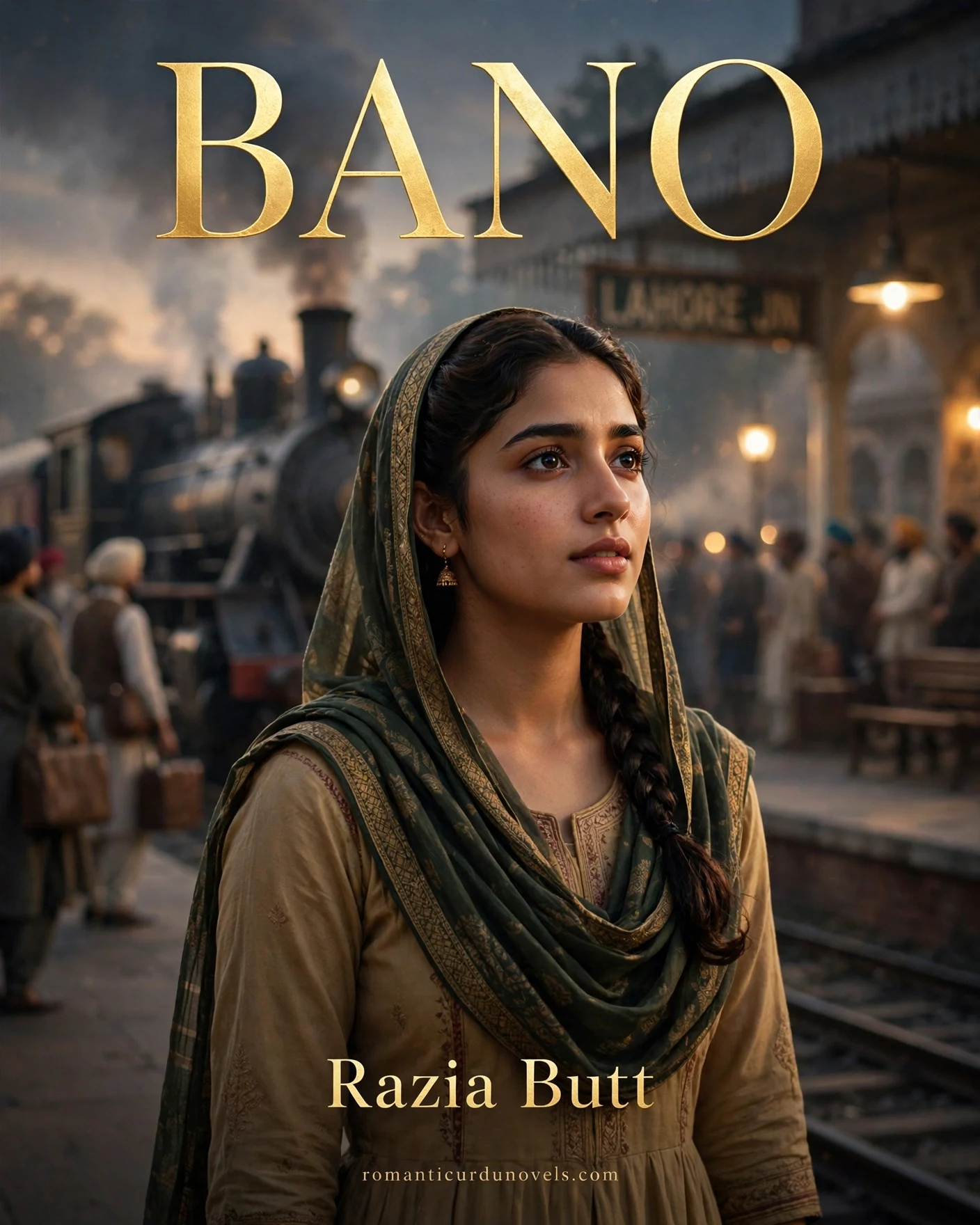
Bano by Razia Butt is one of the most famous Urdu novels ever written about the Partition of India, and this page gives you the complete novel to read online and download as a PDF, together with an honest guide to its story, its characters, and the television drama it inspired.
If you have watched the drama Dastaan, you already know the name Bano.
What many viewers do not know is that Dastaan was adapted from this novel, and the novel came first.
This guide keeps the two separate: what belongs to Razia Butt’s novel is described as the novel, and what belongs to the drama is described as the drama, so you are never misled about which is which.
Bano is not a light love story, and it is important to say that plainly before you begin.
It is a love story, because Bano and Hassan love each other deeply, but it is above all a Partition novel.
The history around the love story is violent and cruel, and the novel does not look away from what Partition did to women and families.
Readers who come looking for an easy romance are often surprised, and that surprise is exactly why an honest summary matters more here than for most novels.
Quick Answer: Bano by Razia Butt is a complete Urdu Partition novel set in Ludhiana before and after 1947, about Bano, a young woman engaged to Hassan, whose life is torn apart by Partition violence and separation. The Hum TV drama Dastaan (2010) was adapted from it. Read the complete novel online or download the PDF using the buttons on this page.
Key Facts
- Novel: Bano (Urdu: بانو), one of Razia Butt’s most famous novels.
- Author: Razia Butt (1924 to 2012), one of Pakistan’s most popular Urdu novelists.
- Setting: Ludhiana in undivided Punjab before Partition, and then Pakistan, in the 1940s and 1950s.
- Heroine: Bano, a young woman from a close-knit Muslim family, engaged to Hassan.
- Theme: love tested by the Partition of India in 1947, and what that upheaval did to ordinary families, especially women.
- Famous adaptation: the Hum TV drama Dastaan (2010) was dramatised from this novel.
- Status: complete novel, available here to read online and download as a PDF.
| Novel Name | Bano |
| Author / Writer Name | Razia Butt |
| Genre | Historical fiction, romance, Partition novel |
| Setting | Ludhiana, Punjab, before and after the Partition of India, then Pakistan |
| Main Characters | Bano, Hassan, Rabia, Suraiya, Saleem |
| Publication | Listed as published in 1971, publisher Ferozsons (see the note on editions below) |
| Language | Urdu |
| Famous Adaptation | Dastaan, Hum TV drama serial, 2010 |
| Also Searched As | Bano novel, Bano by Razia Butt pdf, Dastaan novel, Bano Dastaan |
| Status | Complete novel |
| Availability | Free PDF Download and Read Online |
Bano by Razia Butt: What the Novel Is About
The novel opens in Ludhiana, in undivided Punjab, in a close-knit Muslim family in the years just before Partition.
Bano is a young woman of that household, and Hassan is the man she is engaged to marry.
Their wedding is fixed at a family wedding, the wedding of Hassan’s aunt Suraiya to Bano’s brother Saleem, which brings the two families even closer together.
It is an ordinary, happy beginning.
Razia Butt wants the reader to see normal family life before history broke it apart.
As 1946 turns into 1947, communal tension rises around the family, and riots become frequent.
The world the characters trusted begins to collapse, and the novel follows Bano through the violence that follows.
Her home is attacked, her family is destroyed, and she is separated from everyone she loves.
She survives, but survival costs her almost everything, and she is believed dead by Hassan, who waits for news that never comes.
The middle of the novel is the story of those lost years.
Bano reaches Pakistan after terrible hardship, and she spends years far from home, living under another name and carrying the memory of the life she lost.
Hassan, meanwhile, builds a new life in Pakistan, haunted by the fiancee he believes he has lost forever.
When the two finally meet again, years later, the reunion is not a happy ending in the usual sense.
Too much has happened, and too much has been broken, for the past to simply be restored.
The novel ends in tragedy, and readers should know that before they begin, because the ending is one of the most discussed things about this book.
That tragic shape is the point of the novel.
Bano is not one couple’s bad luck.
It is what Partition did to millions of ordinary people, told through one woman’s life, so history becomes something felt rather than memorised.
Bano puts one family’s suffering first, and that is why it has stayed in print and in memory for so long.
Bano and Hassan: The Main Characters of the Novel
Bano is the heroine, and the novel is named for her.
She begins as a protected, much-loved girl in a happy household, and the novel tests her with losses that would break most people.
What readers remember about her is not only her suffering but her stubborn will to live, to keep her faith, and to keep working for her country even when every door closes to her.
Razia Butt’s heroines are famously strong, and Bano is the strongest example of that pattern, a woman who refuses to be reduced to what was done to her.
Hassan is Bano’s fiance, a decent and loving man who believes Bano is dead and tries, painfully, to live with that belief.
His story is the other half of the novel: the guilt of the survivor, the man who was not there when his family needed him, and who must face, years later, the woman he mourned.
Rabia is the third figure in this triangle, a young woman who loves Hassan and hopes to marry him, and whose choices, made with good intentions, add to the tragedy rather than preventing it.
Suraiya, Hassan’s aunt, and Saleem, Bano’s brother, whose wedding opens the story, bind the two families together, which is why the destruction of those families hurts the reader so much.
No character in Bano is a simple villain or a simple saint.
Even those who hurt Bano act from the chaos of the time, and even those who love her sometimes fail her.
That moral complexity is part of why the novel is still argued about, and it is also why readers who enjoy love stories about patience and separation, like Umera Ahmed’s Teri Yaad Khaar-e-Gulaab Hai by Umera Ahmed, often find Bano the deeper and harder book of the two.
The Themes of Bano: Love, Faith, Sacrifice and the Price Paid by Women
The first theme of Bano is love that survives separation.
Bano and Hassan are separated for years, by violence, by distance, and by the belief that the other is dead, yet neither truly lets go.
The second theme is faith under suffering.
Bano holds to her religion and her sense of duty even when she has lost her home, her family, and her name, and the novel treats that endurance as a form of heroism in itself.
The third theme, and the one that makes Bano different from an ordinary romance, is the price Partition made women pay.
The novel shows, without sensational detail, how women bore the worst of the violence, and how society then judged the very women it had failed to protect.
Bano’s later struggle to find honest work, and to be treated with dignity after everything she has endured, is one of the most painful parts of the book, because it shows that survival was not the end of her troubles.
A fourth theme is patriotism, and here Bano is unusual: she does not only suffer for her country, she wants to work for it, and her frustration when she is pushed aside for being too honest and too outspoken is something many readers recognise even today.
Readers who love novels about a household and a changing world will recognise a kinship with Khadija Mastoor’s Aangan by Khadija Mastoor, another great Urdu novel about women, family, and a society in transition.
Aangan watches a world change slowly, while Bano watches a world collapse in months.
Is Bano a True Story? The Novel and the Real History of Partition
This question is asked about Bano more than about almost any other Urdu novel, so it deserves a straight answer.
Bano is a work of fiction, but it is fiction set inside real history.
The Partition of India in 1947, the riots in Punjab, the great migrations, and the trains carrying refugees between the two new countries all really happened, and the novel draws its power from that reality.
No reliable source presents Bano herself as a documented historical person, and this page does not claim that she was.
What is true is the world she moves through, and the kinds of suffering that real women endured during Partition, which is why the novel feels true even though its heroine is invented.
That distinction matters, because some drama summaries describe Dastaan as based on true events, which describes the Partition events behind the story, not a claim that every scene happened to one real woman.
Readers who want Partition history told as history should read Bano alongside a work of historical fiction written from the other side of the same fire, such as Naseem Hijazi’s Khaak aur Khoon by Naseem Hijazi, which tells the story of 1947 through a different family and a different lens.
Read together, the two novels show how the same catastrophe was imagined by two very different writers.
Dastaan: The Television Drama Adapted from Bano
In 2010, Hum TV aired Dastaan, a drama serial dramatised from Razia Butt’s novel Bano.
The adaptation was written for television by Samira Fazal, directed by Haissam Hussain, and produced by Momina Duraid.
It ran for 23 episodes, with one special episode, from 26 June 2010 to 4 December 2010.
Sanam Baloch played Bano, and Fawad Khan played Hassan, and their performances are a large part of why the drama is still remembered as one of the finest Pakistani serials ever made.
The drama is set between 1947 and 1956, and it follows Bano from her life in Ludhiana through Partition and into Pakistan, just as the novel does.
The drama also reached audiences beyond Pakistan, airing in India as Waqt Ne Kiya Kya Haseen Sitam and in the Middle East under an Arabic title meaning Love Across Borders.
For many younger readers, Dastaan was their first meeting with Bano.
Bano the Novel vs Dastaan the Drama: What Is Different
A drama and a novel are different forms, and Dastaan is an adaptation, not a copy.
The drama compresses, rearranges, and dramatises scenes for television, and some details, dialogue, and emphasis belong to the drama’s writer and director rather than to Razia Butt’s text.
This page therefore treats the two carefully: the story summary above follows the novel as published summaries describe it, while casting, episode count, and broadcast dates belong to the drama and are stated as drama facts.
If you have only watched Dastaan, the novel will still surprise you, because a novel can stay inside Bano’s thoughts in a way no camera can.
Enjoy both, but judge each on its own terms, and never quote a drama scene as proof of what the novel says.
About the Author: Razia Butt (1924 to 2012)
Razia Butt, born Razia Niaz on 19 May 1924, was one of the most popular Urdu novelists Pakistan has ever produced.
She spent most of her childhood in Peshawar, and her name first appeared in a literary journal around 1940, when she was still in her teens.
She later developed her first published story into a novel, Naila, and after marrying in 1946 she resumed writing in the 1950s, going on to write some 51 novels and 350 short stories, as well as radio plays.
One caution about her birthplace: sources disagree, with some giving Rawalpindi and others Wazirabad, so this page states her birth date and her Peshawar childhood, which sources agree on, and asserts neither birthplace as settled fact.
Her novels are famous for strong female protagonists loved by ordinary household readers, which is why she is often compared, for her popularity, with the English novelist Barbara Cartland.
Several of her novels were adapted for film and television, including Naila and Saiqa for the screen, and Najia, Saiqa, and Bano for television.
In 2007, Hum TV bought the rights to eight of her novels, including Bano, which led directly to Dastaan three years later.
She also wrote an autobiography, Bichhray Lamhe, and she died in Lahore on 4 October 2012, after a protracted illness.
Readers who want another Razia Butt novel after Bano can start with her Bisma Novel By Razia Butt, already published on this site, which shows the same strong heroine and the same gift for household drama, in a different story altogether.
Who Should Read Bano, and Who Should Wait
Bano is for readers who want a serious Urdu novel about history, and who are willing to be moved and disturbed by it.
It suits readers interested in Partition, students of Urdu literature, viewers of Dastaan who want the original story, and admirers of strong heroines.
It is also for readers who like novels that mean something beyond the love story, because Bano is, at heart, about what a country owes the women who suffered for it.
It is equally important to say who should wait, or choose something else first.
Bano contains Partition violence and suffering, including violence against women, and its ending is tragic, so it is not light or comforting reading.
If you want a gentle romance, or a novel that ends happily, this is not that book, and one competitor review says so in exactly those words: Bano is not the book for you if you are looking forward to reading a romantic novel.
Readers who want a softer, modern collection about love and feeling after this heavy classic often turn to Farhat Ishtiaq’s Dil Se Niklay Hain Jo Lafz by Farhat Ishtiaq, which offers a very different, gentler kind of reading.
Bano and the Other Great Partition Books in Urdu
Bano does not stand alone in Urdu literature, and reading it beside other Partition books deepens it.
Saadat Hasan Manto’s short, unsparing prose looks at the same catastrophe without flinching and without sentiment, and readers who want that opposite voice should read Manto Nama by Saadat Hasan Manto after Bano.
Where Razia Butt asks you to live inside one woman’s suffering for a whole novel, Manto shows you the same world in sharp, short shocks.
Together they show the full range of what Urdu writing did with Partition, tenderness on one side and anger on the other.
For a completely different kind of classic after Bano, many readers pick up Mushtaq Ahmad Yousufi’s Zarguzasht by Mushtaq Ahmad Yousufi, a book of humour and observation that reminds the reader that Urdu literature can laugh as well as mourn.
That contrast is worth making deliberately: after a tragic novel, a comic classic is not an escape, it is a way of remembering that life, even after Partition, went on.
How to Read Bano Online and Download the Complete PDF
Use the buttons on this page to read Bano online or download the complete PDF.
The buttons point to the full novel file supplied for this page, so you can start reading at once on a phone or a computer, and keep the PDF for offline reading later.
One practical note will save confusion: different editions and scans of this novel show different page counts.
One PDF listing shows 377 pages, while printed editions and other scans differ, so judge completeness by the content, not by the page number on the file you open.
In print, the novel is listed by the publisher Ferozsons, and Pakistani bookshops stock Razia Butt titles regularly.
Readers search for this novel as Bano, Banoo, Bano novel, and Dastaan novel, and all point to the same book.
The spelling used here, Bano by Razia Butt, is the spelling under which the novel is catalogued.
Do not confuse this novel with other books that share the name Bano, or with novels by authors named Hoor Bano or Noor Bano, which are different writers and different books.
Frequently Asked Questions About Bano by Razia Butt
Is Bano by Razia Butt a complete novel?
Yes.
Bano is a complete novel by Razia Butt, and this page offers the complete novel to read online and download as a PDF.
Who wrote Bano?
Razia Butt, one of Pakistan’s most popular Urdu novelists, wrote Bano.
She wrote some 51 novels and 350 short stories, and Bano is counted among her best and most famous works.
When was Bano published?
Bano is listed as published in 1971, by the publisher Ferozsons.
That is the publication date given in the novel’s reference listings.
The story itself is set in the 1940s and 1950s, around Partition.
What is the story of Bano in short?
Bano, a young woman from Ludhiana, is engaged to Hassan when Partition destroys her family and separates them.
Believed dead, she endures years of hardship and reaches Pakistan, while Hassan tries to rebuild his life.
Their reunion, years later, ends in tragedy rather than in a restored happy ending.
Does Bano have a happy ending?
No, and readers should know this before they begin.
The novel ends in tragedy, which is one of the reasons it is remembered so strongly.
Its sadness is deliberate: it is a novel about the real cost of Partition, not a romance with a guaranteed happy ending.
Is Bano a true story?
Bano is fiction set inside real history.
The Partition, the riots, and the migrations it describes really happened, but Bano herself is not presented in reliable sources as a documented historical person.
The novel feels true because the world it describes was true for millions of real people.
Is Dastaan the same as Bano?
Dastaan is the television drama adapted from Bano, not a different novel.
It aired on Hum TV in 2010, was dramatised by Samira Fazal, directed by Haissam Hussain, and starred Sanam Baloch as Bano and Fawad Khan as Hassan.
The drama follows the novel’s story, but as an adaptation it changes and compresses details for television.
How many pages does Bano have?
It depends on the edition.
One PDF listing shows 377 pages, while printed editions and other scans show different counts.
Different layouts of the same novel, not different books, explain the difference.
How can I read Bano online or download the PDF?
Use the Read Online and Download PDF buttons on this page.
They point to the complete novel file supplied for this page.
Is there an English version of Bano?
An English translation of Bano is reported by competitor listings, but this page does not assert a translator or publisher for it, because the listings that mention it give no reliable edition details.
What other novels did Razia Butt write?
Razia Butt wrote about 51 novels, including Naila, Saiqa, Najia, and Bisma, as well as short stories and radio plays.
Her autobiography is titled Bichhray Lamhe, and several of her novels were adapted for film and television.
Is Bano suitable for young readers?
Bano deals with Partition violence, loss, and suffering, including violence against women, and it ends tragically.
It is best suited to adult readers, or to older students reading it with guidance.
Younger readers should start with a lighter Razia Butt novel first.
Final Verdict: Should You Read Bano by Razia Butt?
Bano by Razia Butt earns its place among the great Urdu novels not by being easy but by being true to its subject.
It takes one woman’s life and makes the reader feel what Partition meant, not as a date in a textbook but as a home destroyed, a family scattered, and a love that survived everything except the chance to be happy.
It is painful and tragic, and that is why it is still read and adapted decades after it was written.
Read it when you have the time and the heart for a serious novel, and read it slowly, because Bano rewards the reader who does not rush past her suffering.
Read the complete novel online or download the complete PDF using the buttons on this page, and start at the beginning, in Ludhiana, before the world changed.
And when you want a very different journey after Bano, Mustansar Hussain Tarar’s Undlas Main Ajnabi by Mustansar Hussain Tarar offers a travelogue of discovery and wonder, a reminder that Urdu writing also knows how to look outward with curiosity and hope.
One Comment