Koi Lamha Khuwab Nahi Hota by Umera Ahmed – Complete PDF Download
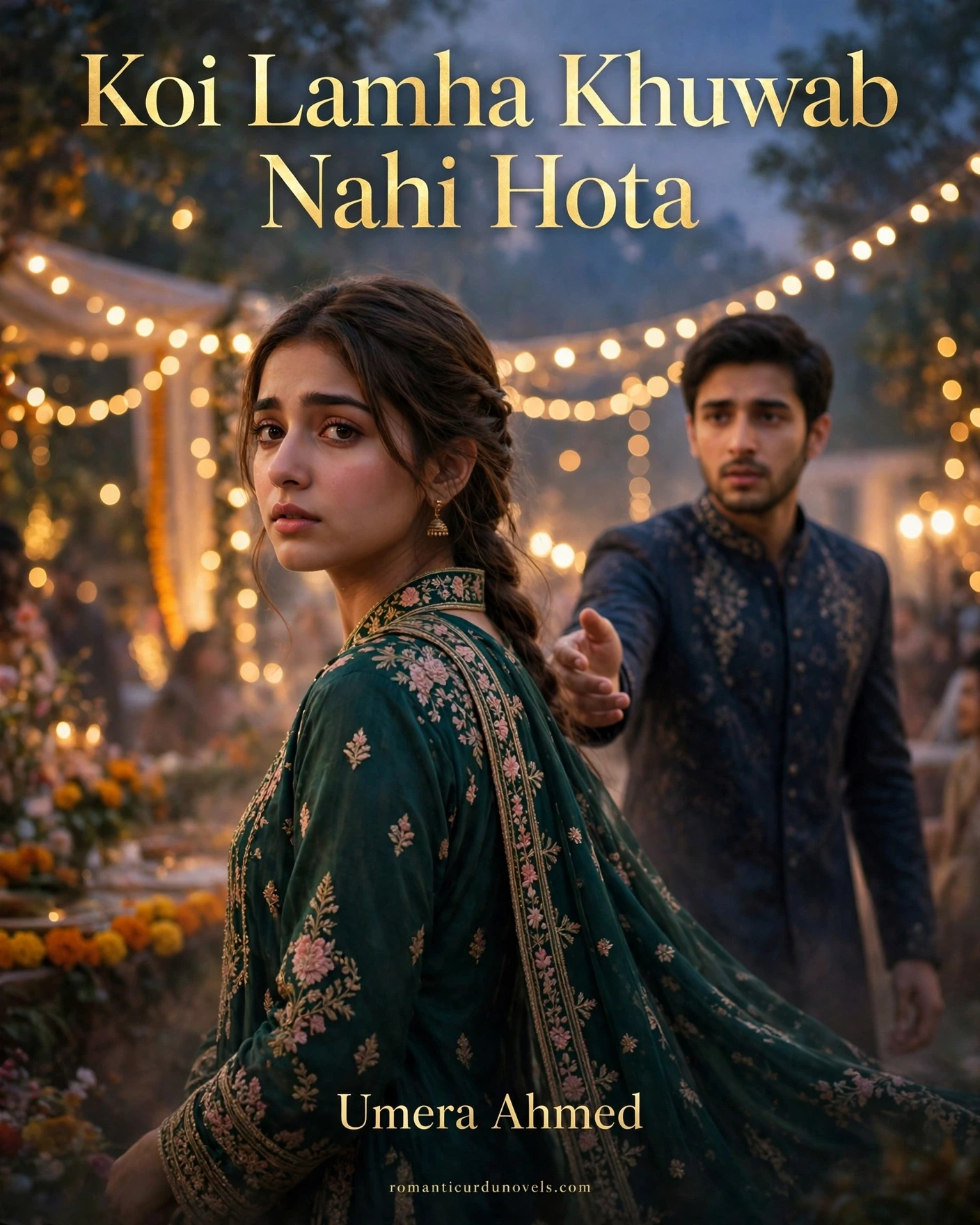
romanticurdunovels.com
Koi Lamha Khuwab Nahi Hota by Umera Ahmed is a short, complete romantic story in Urdu, and this page gives you the full story to read online and download as a PDF, together with an honest guide to what the story actually is, who its characters are, and why readers still search for it years after it first appeared in a monthly digest.
Before you download anything, one fact matters more than any other.
This is not a long, multi-part novel.
It is a short story, closer in length to a novelette than to the big novels Umera Ahmed is famous for.
That is not a weakness.
It is the reason the story works so well in a single sitting, because its whole point is made in one concentrated arc, without filler, without side plots, and without a hundred pages of waiting.
Readers search for this story under several spellings, including Koi Lamha Khawab Nahi Hota, Koi Lamha Khwab Nahi Hota, and Koee Lamha Khwab Nahi Hota.
All of them point to the same story by the same author.
The spelling used on this page, Koi Lamha Khuwab Nahi Hota, is the one used in the title and web address of this page.
Key Facts
- Form: a short story (novelette-length), not a full-length novel.
- Author: Umera Ahmed, one of the most widely read Urdu fiction writers of Pakistan.
- Main characters: Momi and Waleed, as named in the published summaries of the story.
- Genre: social romantic, with a moral and reforming thread, as the download listings describe it.
- First publication: a monthly digest, later gathered into the story collection Main Ne Khuwabon Ka Shajar Dekha Hai.
- Language: Urdu.
- Status: complete, a single self-contained story.
- Availability: complete PDF download and read online on this page.
| Story Details | Information |
|---|---|
| Story Name | Koi Lamha Khuwab Nahi Hota |
| Author / Writer Name | Umera Ahmed |
| Form / Genre | Short story (novelette-length); social romantic |
| Main Characters | Momi and Waleed |
| First Published In | Monthly digest (see the digest note below; sources differ on the digest name) |
| Later Published In | The story collection Main Ne Khuwabon Ka Shajar Dekha Hai |
| Language | Urdu |
| Also Searched As | Koi Lamha Khawab Nahi Hota, Koi Lamha Khwab Nahi Hota, Koee Lamha Khwab Nahi Hota |
| Status | Complete story |
| Availability | Free PDF Download and Read Online |
Koi Lamha Khuwab Nahi Hota: What Kind of Story Is It, Honestly?
The first thing to understand about Koi Lamha Khuwab Nahi Hota is what kind of story it is, because most download pages get this wrong by calling it a full novel and leaving it at that.
It is filed on many websites under Urdu novels, and readers naturally expect a long book with many chapters.
That label is only half true.
In Urdu publishing, short digest stories are routinely sold and listed as novels, and this story is one of them.
The honest description is a short story of novelette length, complete in itself, first written for a monthly digest and later reprinted in a book collection.
One download listing gives the story as 42 PDF pages, with a book-form length of 82 pages, and a file size of 3.95 MB.
Those figures come from a single listing and have not been independently verified, so this page reports them as a listing claim, not as a settled fact.
What is certain is the shape of the story: it is short enough to finish in one sitting, and it is built around one relationship, not a large cast or a long family saga.
Readers who come looking for another Peer e Kamil will therefore find something different here, and that difference should be welcomed, not treated as a disappointment.
Peer e Kamil is a long, philosophical novel that follows its characters over years.
This story is a small, sharp portrait of two young people at one turning point in their lives.
Both are Umera Ahmed, but they ask for different kinds of attention, and the short story asks for yours for an evening, not a month.
The Story in Outline: Momi, Waleed, and a Wedding
The published summaries of the story agree on its basic situation, and this outline follows them without adding invented detail.
Momi comes to stay with her uncle so that she can attend the wedding of her cousin Fari.
There she meets Waleed, who is the neighbour and friend of her cousin Wasif.
Waleed lives with his father and his stepmother, and the summaries describe him as open-minded, with many female friends and a flirtatious nature.
When Waleed meets Momi, he feels something special about her, and Momi feels the same.
That mutual feeling is the starting point of the story, not its end.
The trouble begins when Momi learns about Waleed’s friendships with other girls, and she starts to keep her distance from him.
From that point the story turns on misunderstandings and on what one summary calls complaints of selfishness on each side.
Neither character is painted as simply good or simply bad.
Each sees the other through the lens of hurt pride and wounded feeling, and each complaint makes the next misunderstanding more likely.
The summaries describe the story’s theme as the power of love to change a person’s habits, attitudes, and hobbies, leading a person to focus solely on the one they love.
That is the question at the heart of the story.
Can love genuinely change a person, or does it only make a person hide, for a while, the habits that will return later?
The story does not answer that question with a lecture.
It answers it by showing what happens to these two people, and it leaves the reader to judge whether the change is real.
This page deliberately does not spoil the ending.
The story is short, and its final pages carry the whole weight of its idea.
A reader who knows the ending in advance loses the very experience the story was written to give, which is the slow recognition that a moment which felt like a dream was, in fact, real and consequential.
What Does the Title Mean? No Moment Is a Dream
The title is the best introduction to the whole story, and it is worth translating word by word.
Koi means any or no, lamha means a moment, khuwab means a dream, nahi hota means is not.
In plain English the title reads as No Moment Is a Dream, or, in the fuller sense the story gives it, no moment is merely a dream.
That is a title about the weight of small moments.
A glance, a word spoken carelessly, a silence that lasts a day too long: in ordinary life these feel like nothing, like passing dreams that will fade by morning.
The story insists that they do not fade.
They stay, they shape what two people think of each other, and they decide whether a relationship grows or breaks.
Readers who love Umera Ahmed’s longer work will recognise this way of thinking.
Her stories often turn on a single moral choice or a single moment of recognition, and the rest of the plot is the working out of that moment’s consequences.
Here the idea is given its shortest and clearest form, which is why the title itself has stayed in readers’ minds long after the details of the plot have blurred.
The Characters: Who Momi and Waleed Are
Only two characters carry the story, with the wedding family around them, and that small cast is part of its design.
Momi is the young woman at the centre of the story.
She arrives as a guest, for a wedding, which puts her in the position of an outsider looking into a household that already has its own habits and friendships.
That position matters, because she sees Waleed fresh, without the history that makes his behaviour seem normal to the people around him.
Waleed is the young man she meets there, the neighbour and friend of her cousin Wasif.
He lives with his father and stepmother, a family detail the summaries mention and which helps explain his independence and his easy, open way with people.
He is described as open-minded, with many female friends and a flirtatious nature, and that description is not offered as praise or blame.
It is simply the fact about him that the story tests.
The supporting figures are few and functional.
Fari, the cousin whose wedding brings Momi to the house, gives the story its occasion and its festive background.
Wasif, Fari’s cousin and Waleed’s friend, is the link that brings the two main characters together.
Neither of them needs a long backstory, because the story is not about them.
They exist to set the meeting in motion and then to step back while Momi and Waleed work out what they mean to each other.
Themes: Love, Change, Trust, and Selfishness
The story’s themes are plain enough to name, and each one grows directly out of the plot rather than being imposed on it.
The first theme is love as a changing force.
The summaries agree that the story explores how love can change a person’s habits, attitudes, and hobbies, drawing a person to focus solely on the one they love.
That is a romantic claim, but the story treats it as a question to be tested, not as a slogan to be believed.
Does Waleed change because he loves Momi, or does he only perform change while he wants her attention?
The story lets the reader watch and decide.
The second theme is trust, and its close companion, jealousy.
Momi’s distance from Waleed begins when she learns about his friendships with other girls.
That is not presented as mere suspicion.
It is presented as a reasonable response to a real fact about his way of life, and the story is fair to both sides of it.
Waleed can honestly say his friendships mean nothing more than friendship.
Momi can honestly say that a person who treats every relationship so lightly cannot be trusted with the one relationship that matters most.
The third theme is selfishness, and the complaints of selfishness that the summaries mention on both sides.
Each character accuses the other, in effect, of thinking only of themselves: one of wanting attention without commitment, the other of wanting commitment without understanding.
That mutual accusation is what makes the story feel true to life.
Real misunderstandings are rarely one-sided, and this story refuses to make them so.
From Digest to Book: Where This Story Was First Published
The publication history of this story is short, but it has one point on which sources disagree, and this page states the disagreement plainly rather than hiding it.
All the download listings agree that the story was first published in a monthly digest and is now available in the story collection Main Ne Khuwabon Ka Shajar Dekha Hai.
Two listings, booksonlinepdf and librarypk, name the digest as Khawateen Digest.
A third listing, pdfbooksfree, says only that it was first published in a monthly digest, without naming it.
This page therefore reports Khawateen Digest as the named claim of two sources, with one source leaving the digest unnamed, and it does not present a single digest name as independently confirmed.
Readers who own a printed digest copy can settle the point, and this page will be glad to correct the note on that evidence.
What is not in dispute is the book form.
The story now appears in Main Ne Khuwabon Ka Shajar Dekha Hai, the collection whose title story is the famous Main Ne Khuwabon Ka Shajar Dekha Hai itself.
The listings of that collection name, alongside this story, companions such as Shehr-e-Zaat, Muthi Bhar Mitti, and Teri Yaad Khaar-e-Gulaab Hai, though the listings differ on whether the collection holds five or six stories, and on the exact roster.
Readers who enjoy this story will therefore find its natural next step in the rest of the same collection, and in Teri Yaad Khaar-e-Gulaab Hai, another short work from the same period that is also listed among the collection’s companions.
About the Author: Umera Ahmed
Umera Ahmed is one of the most widely read and well-known Urdu fiction writers and screenplay writers of Pakistan, and the listings repeat that description because it is, by any measure, true.
She completed her Masters in English Literature from Murray College, Sialkot.
She started her writing career in 1998 at a very young age.
Her early stories were published in the monthly Urdu digests and later gathered into books, which is exactly the path this story followed.
It was her novel Peer e Kamil that became her identity, in the words of the listings, and her stories have since been adapted for television drama to wide audiences.
That fame sometimes hides the short fiction, but the short fiction is where her moral clarity is often at its sharpest, because a short story cannot hide behind length.
Every sentence must earn its place, and Koi Lamha Khuwab Nahi Hota is a good example of that discipline.
For new readers, this story is an ideal first encounter with Umera Ahmed.
It asks for one sitting, it introduces her central concerns, love, faithfulness, self-knowledge, and the moral weight of ordinary choices, and it leaves the reader ready for the longer works rather than exhausted by them.
Who Should Read This Story, and How Long Does It Take?
This story suits readers who want a complete, satisfying read in a single sitting, without committing to a long novel.
It is less suited to readers who want a long, detailed novel with many characters, subplots, and a slow build.
Those readers will be happier starting with Peer e Kamil or Man-o-Salwa, and returning to this story later as a short companion piece.
As for reading time, the story’s short length means most readers will finish it in one sitting of well under an hour, depending on reading speed and on whether the PDF is read on a phone or on paper.
That short sitting is part of the pleasure.
The story is designed to be read whole, held in the mind whole, and thought about afterwards, rather than picked up and put down over many days.
What Other Download Pages Miss, and What to Watch Out For
Most pages that offer this story are thin, and a reader who only visits them will come away with less than this page gives, and in one case with something actively wrong.
The commonest weakness is thinness.
The typical download page gives the title, the author, and a download button, with two or three sentences of summary copied from another site.
It does not explain that the story is a short story rather than a full novel.
It does not name the collection in which the story now appears.
It does not discuss the themes, the characters, or the title’s meaning.
It offers no answers to the questions readers actually ask, such as whether the story is complete, how long it is, and how it relates to the collection.
A third weakness is the confusion between the story and the collection.
Several pages list this story and the Main Ne Khuwabon Ka Shajar Dekha Hai collection interchangeably, sometimes under the same title and sometimes with the same download file.
This page keeps them separate, because they are separate works, even though one now contains the other.
A reader who wants this story alone, and a reader who wants the whole collection, are looking for different files, and they deserve to know which one they are getting.
More Umera Ahmed Stories to Read Next
Once this story is finished, the most natural next step is the collection that now contains it.
Reading Main Ne Khuwabon Ka Shajar Dekha Hai whole gives the title story itself, a longer and more psychological work, together with this story and its companions, and it shows how Umera Ahmed’s short fiction hangs together as a body of work rather than as isolated pieces.
Readers who want to move from the short form to the full novel should go to Peer e Kamil, the work that made Umera Ahmed’s name, and then to Kankar and Man-o-Salwa, which show her handling of social questions and family saga at full length.
Frequently Asked Questions About Koi Lamha Khuwab Nahi Hota
Is Koi Lamha Khuwab Nahi Hota a complete story?
Yes, it is a complete, self-contained short story, not an incomplete serial and not a part of a longer novel left unfinished. It can be read on its own from beginning to end.
Is Koi Lamha Khuwab Nahi Hota a novel or a short story?
Strictly, it is a short story of novelette length, first published in a monthly digest and later included in a story collection. Download sites commonly list it as a novel, because short digest fiction is routinely filed that way, but the honest form is a short story, and this page describes it as one.
Who are the main characters of Koi Lamha Khuwab Nahi Hota?
The main characters are Momi and Waleed, as named in the published summaries. Momi comes to stay with her uncle for her cousin Fari’s wedding, and there she meets Waleed, the neighbour and friend of her cousin Wasif.
What is the story of Koi Lamha Khuwab Nahi Hota about?
It is about Momi and Waleed, who feel something special for each other when they meet at a wedding, and about the misunderstandings that follow when Momi learns of Waleed’s friendships with other girls. At theme level it explores how love can change a person’s habits and attitudes, and how trust is tested by jealousy and by complaints of selfishness on both sides.
Where was Koi Lamha Khuwab Nahi Hota first published?
It was first published in a monthly digest. Two listings name Khawateen Digest, while another listing names no digest, so this page reports the digest name as a claim of two sources rather than as independently confirmed. It is now available in the story collection Main Ne Khuwabon Ka Shajar Dekha Hai.
Is Koi Lamha Khuwab Nahi Hota part of Main Ne Khuwabon Ka Shajar Dekha Hai?
Yes, the story is now included in that collection, alongside companions such as Shehr-e-Zaat, Muthi Bhar Mitti, and Teri Yaad Khaar-e-Gulaab Hai, though listings differ on the exact roster. The story and the collection are separate works, and a file of one is not the same as a file of the other.
How long is Koi Lamha Khuwab Nahi Hota?
It is a short story that most readers finish in a single sitting. One listing gives 42 PDF pages and 82 book-form pages, but those figures come from a single listing and are reported here as a claim, not as a verified fact.
Can I read Koi Lamha Khuwab Nahi Hota online and download the PDF?
Yes, this page provides both options using the buttons on this page, once the owner-supplied file link is in place. The Read Online button opens the story for reading, and the Download PDF button downloads the complete file.
Is Koi Lamha Khuwab Nahi Hota a romantic story?
Yes, it is a social romantic story with a moral and reforming thread, as the download listings describe it. Its romance is serious rather than light, because it turns on trust, faithfulness, and whether love genuinely changes a person.
What should I read after Koi Lamha Khuwab Nahi Hota?
The natural next step is the collection Main Ne Khuwabon Ka Shajar Dekha Hai, which contains this story, then the companion short work Teri Yaad Khaar-e-Gulaab Hai, and then the full novels Peer e Kamil, Kankar, and Man-o-Salwa for readers ready for longer Umera Ahmed fiction.
Final Words on Koi Lamha Khuwab Nahi Hota
Koi Lamha Khuwab Nahi Hota earns its place among Umera Ahmed’s most remembered short works not by length, but by honesty.
It takes one meeting, one misunderstanding, and one question, whether love truly changes a person, and it refuses to answer that question cheaply.
That is why readers return to it, and why its title has stayed alive in search after search.
No moment, the story says, is only a dream.
Every moment leaves something behind, and the wise reader is the one who notices it before it is too late.