Ya Khuda by Qudratullah Shahab – Complete PDF Download
romanticurdunovels.com
Ya Khuda by Qudratullah Shahab is one of the most painful and most honest pieces of Urdu writing about the Partition of India in 1947, and this page gives you the complete work to read online and download as a PDF, together with a clear and honest guide to what it is, what it is about, and why it still matters.
The title itself is a cry, not a decoration.
Ya Khuda means O God, the words a person reaches for when human help has failed and there is nowhere else left to turn.
One honest point matters before anything else on this page.
Most download pages call Ya Khuda a novel, and you will search for it as a novel, so this page uses that word where searchers need it.
But in literary terms it is not a full length novel at all.
It is a novelette, a long short story, first published in 1948, telling one woman’s Partition journey in a short, concentrated space.
This is not a light read, and it is important to say that plainly.
Ya Khuda deals with the violence done to women during the Partition, with refugee camps, and with exploitation by the very people who were supposed to protect the refugees.
Nothing here describes that violence in graphic detail: the guide stays at theme level, because the point is moral witness, not shocks.
Quick Answer: Ya Khuda by Qudratullah Shahab is a Partition novelette, a long short story first published in June 1948, about a young Muslim woman who flees the riots of 1947 and faces abuse and exploitation at every stage of her journey, from eastern Punjab to western Punjab and finally to a refugee camp in Karachi. Commonly listed as a novel, it is short, concentrated, and written as moral witness rather than romance. Read it online or download the PDF using the buttons on this page.
Key Facts
- Work: Ya Khuda (Urdu: یا خدا, meaning O God), a Partition novelette by Qudratullah Shahab.
- Author: Qudratullah Shahab (1917 to 1986), Urdu writer, civil servant, and diplomat, best known for his autobiography Shahab Nama.
- First appearance: June 1948, in the Fasadaat (riots) Number of the journal Naya Daur.
- Form: a novelette, a long short story, commonly searched and shelved as a novel.
- Subject: the Partition of India in 1947, migration, refugee camps, and the exploitation of refugee women.
- Setting: eastern Punjab, western Punjab, and a refugee camp at Eidgah Maidan in Karachi.
- Language: Urdu.
- Status: complete work, available here to read online and download as a PDF.
| Ya Khuda Details | Information |
|---|---|
| Work Name | Ya Khuda (یا خدا) |
| Author Name | Qudratullah Shahab |
| Work Form | Novelette, a long short story, commonly listed as a novel |
| First Published | June 1948, in Naya Daur, Fasadaat Number |
| Subject | Partition of India 1947, migration, refugee women |
| Setting | Eastern Punjab, western Punjab, Karachi Eidgah Maidan camp |
| Language | Urdu |
| Work Status | Complete |
| Availability | Free PDF download and read online |
What Ya Khuda Really Is, and Why the Form Matters
The first question any honest guide must answer is what kind of work Ya Khuda is, because the answer decides how you should read it.
A research study on the evolution of the Pakistani Urdu novelette begins its history with this very work, describing it as Shahab’s novelette Ya Khuda in the June 1948 Fasadaat Number of Naya Daur.
A literary survey of the post independence period calls it a satirical long short story, or novella, as some would put it, and in the same passage also calls it a short story.
Popular download pages and booksellers, meanwhile, call it a novel without qualification.
The fairest description brings these together: Ya Khuda is a novelette, longer than a short story but far shorter than a full novel.
The novelette form leaves no room for side plots, comic relief, or slow world building.
Every scene serves the central journey, and the reader feels that pressure from the first page to the last.
A novelette like this one cannot, which is why readers often finish it in a single sitting and then sit quietly for a long time afterwards.
If you came here expecting a long romantic novel, this section is your warning and your invitation at once.
There is no romance plot here, no hero waiting to rescue the heroine, and no happy domestic ending of the kind romance readers expect.
For readers who do want a long love story after this one, Bano by Razia Butt is a very different kind of book, and the contrast shows just how wide Urdu writing really is.
But judged on its own terms, as a short work of witness, it belongs among the most important Partition writings in Urdu.
The Story at Theme Level
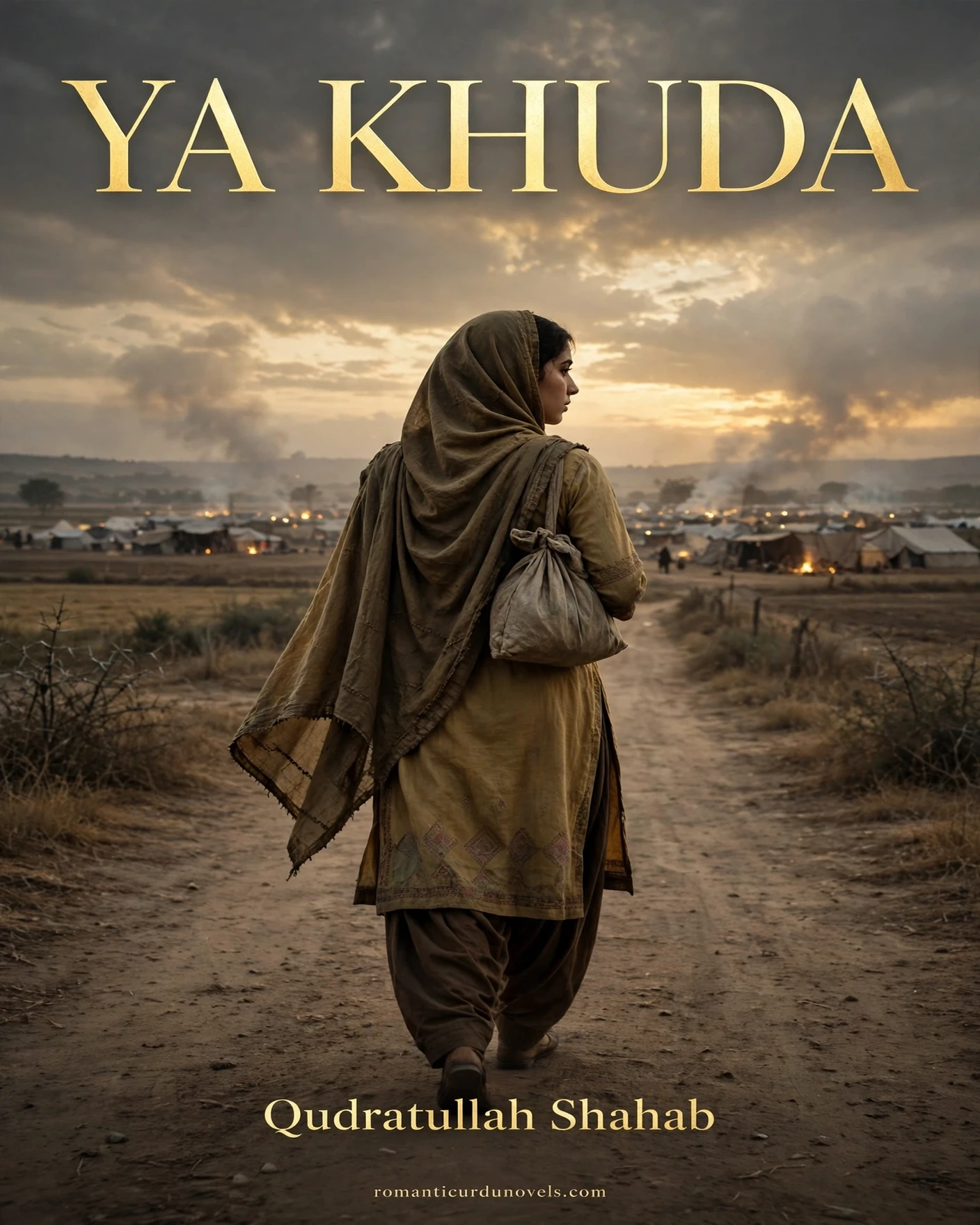
Ya Khuda follows a young Muslim woman at the centre of the Partition upheaval, from the riots that drive her from her home, through flight across Punjab, to a refugee camp in Karachi.
The story is told as a journey with no safe stopping place, and each new place that promises safety turns out to hold a new form of danger.
That structure is the moral argument of the work: the woman flees violence committed by strangers, only to meet exploitation by people who should have been her protectors.
Shahab’s point is not that one community was innocent and another guilty, but that power, wherever it sits, can turn cruel when nobody is watching the vulnerable.
The journey passes through eastern Punjab, where the riots begin, then western Punjab, and finally the refugee camp established at Eidgah Maidan in Karachi.
At each stage the heroine is abused by different men in different positions, and the story refuses to soften that pattern into a single villain.
Volunteers, rescue workers, and government officials, the very people a refugee is told to trust, are shown exploiting refugee girls and women.
That exposure made the work controversial when it first appeared, and it still makes it uncomfortable to read today.
This guide describes the pattern in general terms only, because the work’s force lies in its moral clarity, not in graphic description.
The bitterest part of the satire comes at the end of the journey.
Having fled across a new border in search of a homeland where she would be safe, the heroine finds that survival in Pakistan itself forces her into prostitution to earn a living.
Shahab, in his introduction, said he had himself witnessed such women at Karachi’s Eidgah Maidan years after Partition, women who appeared to be selling pakoras and were in fact surviving through prostitution.
That first hand observation lifts Ya Khuda above invented melodrama: the author had seen the camps, and wrote what he had seen, even when it shamed his own side.
One honest note about the heroine’s name belongs here, because different sources name her differently and a good guide should not pretend otherwise.
The literary survey of the post independence period calls her Shamshaad, while popular novel pages call her Dilshad, and an academic thesis on Partition narratives writes the name as Dil Shad.
The sources consulted here do not settle the point.
This guide therefore speaks of the young woman at the centre of the story rather than fixing one name as certain.
What does not vary across sources is her journey, her suffering, and the moral charge Shahab builds from it.
What the Title Ya Khuda Means
Ya Khuda is a direct address to God, best translated as O God, and in Urdu it carries the weight of a cry rather than a prayer of thanks.
It is what a person says when every human door has closed and language itself seems too small for what has happened.
Academic writing on Partition literature makes exactly this point about the title, that it rings in the mind and symbolises utter helplessness in the face of inhuman treatment.
That helplessness is not presented as weakness in Shahab’s work.
It is presented as evidence, the sound a human being makes when the world has stopped behaving humanely.
The Partition Background You Need Before Reading
In August 1947, British India was divided into India and Pakistan, and Punjab was split between them.
Millions of people crossed the new border in both directions, Muslims moving toward Pakistan and Hindus and Sikhs moving toward India, often on foot, often under attack.
Looting, killing, and the abuse of women accompanied the migration, and refugee camps sprang up in cities like Lahore and Karachi.
Ya Khuda is set inside that migration, and its heroine follows the real route of real refugees, from one Punjab to the other and on to Karachi.
Understanding the camps matters as much as understanding the riots, because the second half of Ya Khuda’s charge is aimed at the camps themselves.
A camp is supposed to be where danger ends and help begins, with food, shelter, and rescue work organised by the new state.
Shahab shows how, in the chaos of those camps, that machinery could itself become a hunting ground, where officials and volunteers used their power over desperate women for themselves.
That is a harder truth to write than a story about enemy violence, because it accuses the reader’s own side.
Readers who want a full length Partition novel to read alongside this short work will find Khaak aur Khoon by Naseem Hijazi a powerful companion, because it too follows ordinary people through the violence and displacement of 1947, at novel length.
Why Critics Argued About Ya Khuda When It Appeared
When Ya Khuda first appeared in 1948, it was criticised by progressive writers and critics despite what its defenders called its detached realism and impartiality.
Part of the anger came from the foreword by Mumtaz Shirin, a leading woman critic perceived by the left as demanding loyalty to Pakistan.
The deeper quarrel was about method: Shirin had argued, in her critical book Meyaar, that riot literature fails when it only piles up bloodshed and agony, and succeeds only when the riots are seen against a larger historical, social, and political background, as a tragic incident experienced by a whole nation.
She held up Ya Khuda as a work that met that standard.
The progressive criticism also touched a genuine literary question: should a writer be impartial, or take a side?
Some writers of the period aimed for a balanced picture, showing equal suffering on both sides of the border, and Shirin criticised that balance as a false even handedness that hid who had actually borne the brunt of the migration massacres.
Shahab’s approach was different again: he was ruthless toward everyone who exploited the vulnerable, including Muslims in Pakistan, and that even handed ruthlessness pleased neither camp fully.
Satire, in his hands, means exposing the gap between what institutions claim to do and what they actually do.
Qudratullah Shahab: The Civil Servant Who Wrote It
Qudratullah Shahab was born on 26 February 1917 in Gilgit and died on 24 July 1986 in Islamabad, and his life explains why Ya Khuda sounds like testimony rather than invention.
After an MA in English literature from Government College Lahore in 1941, he joined the Indian Civil Service, and after Partition he rose to the highest levels of Pakistan’s bureaucracy.
He served as Principal Secretary to three heads of state, Ghulam Muhammad, Iskander Mirza, and Ayub Khan, so he saw the new state’s machinery from the inside.
Shahab’s literary career began with fiction well before Partition, and biographical accounts name his early novel Chandravati, published in 1938, as his first novel.
After Ya Khuda in 1948 came his fiction collections Nafsane, Maan Ji, and Surkh Feeta, and he helped found the Pakistan Writers Guild in 1959.
Yet for most of his life he was known to the public mainly as a bureaucrat, and his fame as a writer came late, after his death.
That late fame rests on Shahab Nama, his autobiography, finished before his death but published posthumously in 1986, a sprawling memoir of politics, spirituality, and personal life that became one of the best selling books in Urdu.
Readers who discover Shahab through Ya Khuda often go on to Zarguzasht by Mushtaq Ahmad Yousufi next, and the two works make a natural pair: the short, sharp fiction of 1948 and the vast memoir of a lifetime, both by a man who stood inside power and wrote about what power does to people.
How to Read Ya Khuda Well
Because Ya Khuda is short, the temptation is to rush through it, but rushing is the worst way to read it.
Read it in one or two sittings, slowly, and give each stage of the journey time to register before moving to the next.
Notice how the places change but the pattern of exploitation repeats, and how Shahab’s prose stays controlled even at its worst.
That control is the style: a civil servant’s precise sentences carrying unbearable facts, without shouting and without letting the reader off the hook.
A second reading habit helps even more: read with the Partition map in mind.
Keep the route in view, eastern Punjab to western Punjab to Karachi, and ask at each stop who holds power over the heroine and what they do with it.
Students will find this route question a strong essay spine, turning a painful story into an argument about institutions, gender, and failed protection.
The work is also a recognised starting point for studying the Pakistani Urdu novelette.
Students who enjoy tracing how Urdu fiction grew after Partition may also enjoy Aangan by Khadija Mastoor, which shows a very different kind of Urdu storytelling, the reflective essay tradition, and the contrast sharpens what makes Shahab’s concentrated fiction distinctive.
A final reading note, offered with respect: this work deals with sexual violence in war, and some readers will find it distressing.
There is no shame in reading it in short stretches, or in reading this theme level guide first and the full text when you feel ready.
The complete text is available through the buttons on this page whenever you are ready for it.
Ya Khuda, Shahab Nama, and Maan Ji: Three Different Works
New readers often confuse Shahab’s books with each other, so this section separates them cleanly.
Ya Khuda is the short Partition fiction of 1948, the subject of this page.
Shahab Nama is something else entirely: a long autobiography published in 1986, covering Shahab’s life, his years at the top of government, his family, and his spiritual life, running to more than a thousand pages.
Shahab Nama will not give you Ya Khuda, and Ya Khuda will not tell you Shahab’s life story.
Maan Ji, the third name that causes confusion, is a separate collection of short stories by Shahab, and it is also the next work in this site’s completion programme.
Its stories belong to Shahab’s fiction collections alongside Nafsane and Surkh Feeta, not to the autobiography and not to Ya Khuda.
If you search for Maan Ji and land on this page, use the buttons here only for Ya Khuda, and wait for the dedicated Maan Ji page for that collection.
Editions, Page Counts, and the Download Confusion
One practical confusion deserves an honest paragraph, because it affects every reader trying to download Ya Khuda.
The work first appeared in a journal in 1948, then circulated in book form in several editions across the decades, and booksellers and e-book listings now give different years and page counts for different editions.
Reference listings mention a 1972 edition, a Lahore Academy edition cited as 1986, and a Sang-e-Meel reprint dated 2014.
This page therefore asserts no single page count as a fact, because any one number would be true of one edition and false of another.
The same caution applies to the popular claim that Ya Khuda is divided into three parts with grand theological titles.
Scholarly descriptions consulted for this guide describe one continuous journey, not a three part structure, and the three part claim appears only on popular pages that also get other details wrong.
This guide does not repeat that claim as fact.
The same rule is applied across this site’s serious Urdu pages, and readers who value that honesty may like Manto Nama by Saadat Hasan Manto, a collection introduced with the same care about what is verified and what is not.
Check the edition inside your downloaded PDF, its publisher and year, to know exactly which Ya Khuda you are holding.
Read Ya Khuda Online or Download the Complete PDF
The complete work is available here both ways: read online in your browser, or download the complete PDF for offline reading.
Use Read Online to start immediately, and Download PDF to read on a phone or tablet, share with a class, or keep for revision.
Both buttons lead to the same complete work, so choose whichever suits your device and your reading habit.
Frequently Asked Questions About Ya Khuda by Qudratullah Shahab
Is Ya Khuda by Qudratullah Shahab a novel?
In popular listings it is called a novel, and you can search for it that way, but in literary terms it is a novelette, a long short story first published in June 1948.
It is much shorter than a full novel, and it tells one concentrated journey rather than a sprawling multi plot story.
Who wrote Ya Khuda?
Qudratullah Shahab, the Urdu writer, civil servant, and diplomat (1917 to 1986), best known for Shahab Nama.
He wrote Ya Khuda from close observation of Partition and the refugee camps.
When was Ya Khuda first published?
It first appeared in June 1948, in the Fasadaat Number of the journal Naya Daur.
It later circulated in several book editions, which is why booksellers give different years.
What is the story of Ya Khuda?
At theme level, it follows a young Muslim woman fleeing the 1947 riots, from eastern Punjab to western Punjab and finally to a refugee camp at Eidgah Maidan in Karachi, where she faces abuse and exploitation at every stage, including by supposed protectors.
This guide stays at theme level and gives no graphic detail.
What is the heroine of Ya Khuda called?
Sources disagree.
A literary survey calls her Shamshaad, popular pages call her Dilshad, and a thesis writes Dil Shad.
Your edition will give the name it uses.
Is Ya Khuda a romantic novel?
No.
It is not a romance, and it has no romantic hero or happy domestic ending.
It is a serious Partition work about violence, migration, and exploitation, written as moral witness and satire.
What does Ya Khuda mean?
Ya Khuda means O God, a cry of helplessness spoken when human help has failed.
Critics of Partition literature note that the title symbolises utter helplessness in the face of inhuman treatment, and that cry is the emotional centre of the whole work.
Is Ya Khuda the same as Shahab Nama?
No.
Shahab Nama is Shahab’s long autobiography, published posthumously in 1986, covering his life and government career.
Ya Khuda is his short Partition fiction from 1948.
They share an author but are entirely different books.
Is Ya Khuda the same as Maan Ji?
No.
Maan Ji is a separate collection of short stories by Shahab, alongside Nafsane and Surkh Feeta.
It is a different work from Ya Khuda, and it has its own dedicated page in this site’s programme.
How many pages is Ya Khuda?
No single page count is asserted here, because editions differ and listings disagree.
The work is short, readable in one or two sittings.
Is there an English version of Ya Khuda?
An English translation by Faruq Hassan is discussed in Partition literature criticism.
This page offers the Urdu work.
How can I read Ya Khuda online or download the complete PDF?
Use the buttons on this page.
Read Online opens the complete work in your browser, and Download PDF saves the complete work for offline reading.
Both lead to the same complete work.
Why is Ya Khuda still famous after more than seventy five years?
Because it told an uncomfortable truth others avoided: refugees fleeing violence could meet exploitation from their own side, in the camps meant to protect them.
Is Ya Khuda suitable for school or college study?
Yes, with a teacher’s guidance, because it deals with sexual violence in war.
It is a recognised starting point for studying the Pakistani Urdu novelette.
Final Verdict: Should You Read Ya Khuda?
Ya Khuda by Qudratullah Shahab is not an easy book, and this guide has not pretended otherwise.
It is short, painful, and morally uncompromising, asking its reader to witness what Partition did to a woman who trusted a new homeland would mean safety.
For readers who want only entertainment, there are better choices on this site.
For readers who want to understand Partition, Urdu literature, and the responsibilities of power, there are few better places to start, and no shorter one.
Read the complete work using the buttons on this page, read it slowly, and give its cry, Ya Khuda, the attention it has demanded since 1948.