
Jab Zindagi Shuru Hogi by Abu Yahya – Complete PDF Download
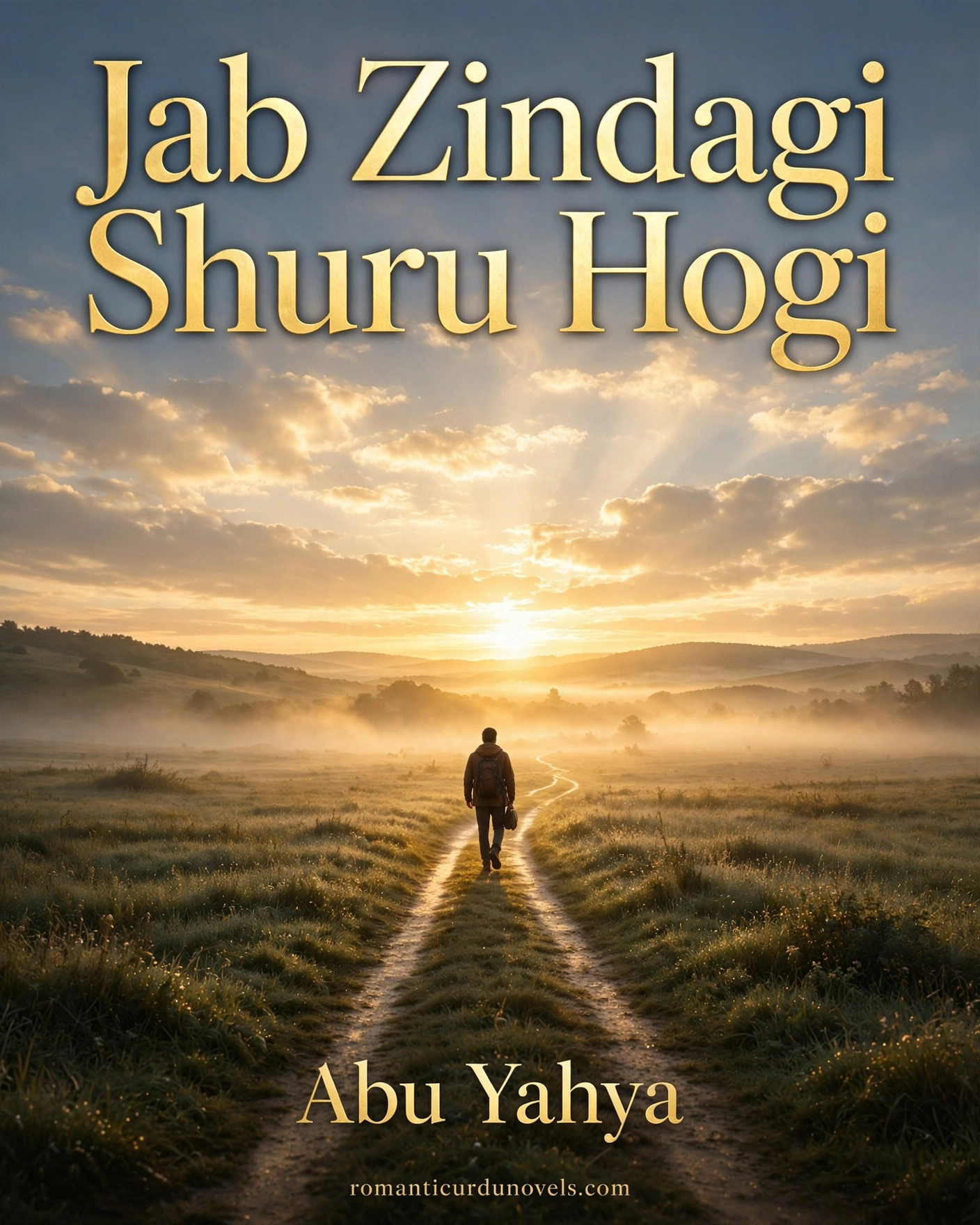
romanticurdunovels.com
| Book Details | Information |
|---|---|
| Book Name | Jab Zindagi Shuru Hogi (جب زندگی شروع ہوگی) |
| Author Name | Abu Yahya (Rehan Ahmed Yousufi) |
| Book Genre | Islamic Novel, Afterlife, Faith and Accountability |
| Book Status | ✅ Complete (Part 1 of the series) |
| Language | Urdu (English translation: When Life Begins) |
| Availability | Free PDF Download and Read Online |
Jab Zindagi Shuru Hogi Novel: What It Really Is
The novel belongs to a rare kind in Urdu literature: the afterlife novel.
Most Urdu novels are set in homes, cities and families in this world.
This one begins where worldly novels end, at death, and continues into Barzakh, the Day of Judgement, the Plain of Judgement, and Paradise.
Its story is built upon the descriptions of the Day of Reckoning and the Hereafter as related in the Quran and Sunnah, and it presents them as a preview, in story form, of what may unfold when people are raised from their graves.
Two things about the book must be understood before you start reading, and both of them protect the reader from disappointment.
First, this is a novel, not a book of religious rulings.
One respected reviewer put it plainly: the book is a bold imaginative attempt, and it should be read as a novel, as an introduction and a starting point for your own study of the Quran, not as a religious text itself.
Its scenes are the author’s storytelling imagination built on scriptural descriptions, and they are meant to move the heart and wake up the conscience, not to settle questions of belief on their own.
Second, this is not a romance novel in the usual sense.
There is love in it, the deep love of a husband and wife and of parents for their children, but its subject is accountability, not courtship.
Anyone opening it expecting a love story will be surprised.
Anyone opening it to reflect on life, death and what comes after will find exactly what they came for.
What Does Jab Zindagi Shuru Hogi Mean?
The title is the novel’s message.
Jab Zindagi Shuru Hogi means “When Life Begins”.
The idea behind it is simple and searching: the years we spend in this world, however long they feel, are short and temporary, while the life after death is eternal.
In that sense, the novel argues, true life has not begun yet.
It begins when a person leaves this world and stands for reckoning, and the quality of that eternal life depends on the deeds, intentions and character of the life lived here.
That is why the English translation carries the same title, When Life Begins.
Readers also search for the book under variant spellings, “Jub Zindagi Shuru Hogi” and “Jab Zindagi Shuru Ho Gi”.
All of these spellings refer to the same book, Part 1 of Abu Yahya’s series, by the same author.
If a listing spells it differently, check the author name, Abu Yahya, and you will know you have found the right book.
Jab Zindagi Shuru Hogi Story: The Journey Through the Hereafter
The novel follows Abdullah, a father, and his angel companion Saleh, as they move through the stages of the Hereafter.
Abdullah has died a gentle death and rested in Barzakh, the waiting world between death and resurrection, where Saleh kept him company.
When the Day of Judgement begins, the familiar world is gone.
The earth lies desolate under a burning sky, people panic and blame one another, and every person waits for their account to be taken.
Saleh wakes Abdullah from his reflections and urges him to prepare, because the Day has truly started.
Readers moved by this journey may also enjoy Manto Nama by Saadat Hasan Manto, another complete novel on romanticurdunovels.com.
From there the journey moves, stage by stage, through the shade of the Throne, where Abdullah sees himself as God sees him, through his faith and deeds rather than his worldly appearance, and on to Araf, the heights where nations gather by their prophets and Abdullah meets revered prophets who congratulate him yet carry a grave concern for humanity’s fate.
Then comes the Plain of Judgement, Maidan-e-Hashar, where the heat and the crowding strip away every pretence.
Here Abdullah sees people he knew in life, including his former teacher, and learns the novel’s hardest lesson: that knowledge without action, wealth without humility, and a life of luxury without accountability all stand exposed on this plain, whatever a person’s status was in the world.
The story then turns to witnesses and reckoning: the testimony of Prophet Jesus, the Fountain of Kausar, the account of deeds, and the fate of nations and of those who changed their faith.
Through all of it, Saleh explains each scene as it unfolds, answering Abdullah’s questions and, through him, the reader’s questions.
The journey ends where the title promises it will end, with entry into Paradise, where life, in the novel’s sense, finally begins.
The complete Urdu audio of the novel follows this same order in fifteen parts, from Roz-e-Qayamat (the Day of Judgement) and Arsh kay Sa’ay Mein (in the shade of the Throne) through Maidan-e-Hashar, Naima, Hoz-e-Kausar par (at the Fountain of Kausar), Hisaab Kitaab (the reckoning), and finally Jannat Ki Baadshahi Mein Daakhla (entry into the kingdom of Paradise).
That part order is a useful map if you want to read the novel in sittings rather than in one go.
Jab Zindagi Shuru Hogi Characters: Abdullah, Saleh and Naimah
Abdullah is the main character and the reader’s guide.
He is an ordinary believing man, a father, who lived a life of devotion, good deeds and kindness, and who now discovers what that life has earned him.
He is not a hero of battles or romance.
His heroism, if the word fits, is the quiet kind: faith held through an ordinary life, and love for his family that survives death itself.
His grief, wonder and questions carry the whole novel, because they are the questions any reader would ask in his place.
Saleh is Abdullah’s angel companion, who has been with him since his earthly life and who stays beside him through the Hereafter.
Saleh explains, warns, teases gently, and answers.
When Abdullah longs to meet his wife but hesitates to say so directly, Saleh teases him about wrapping his feelings in formality, then arranges the meeting.
When Abdullah is shaken by what he sees on the Plain of Judgement, Saleh gives him the moral meaning of each scene.
In storytelling terms, Saleh is the teacher inside the story, and through him Abu Yahya teaches the reader without ever breaking the narrative.
Naimah is Abdullah’s wife, and their reunion is the emotional heart of the novel.
When Abdullah finally sees her, light seems to radiate from her, and the couple talk of their struggles in mortal life, their faith, and the rewards they hoped for.
Their joy is real, but it is interrupted: Saleh reminds them that the reckoning is not finished, and Abdullah must return to the Plain of Judgement.
That interruption is the novel in miniature, joy and accountability held together.
Their children matter just as much to the story.
Some of them are in bliss, while a son and a daughter are in misery, and the novel traces, with great tenderness and pain, why each one is in the state they are in.
Abdullah’s distress over his children, especially over what they may feel and what their choices cost them, gives the book its most human moments, and its most searching question for parents reading it: what do we actually pass on to our children?
Themes of Jab Zindagi Shuru Hogi: What the Novel Teaches
Accountability.
The novel’s first and largest theme is that every deed counts, and that the Day of Judgement reveals what a person truly was, stripped of wealth, reputation and excuses.
A teacher is judged by his actions, not his learning.
A businessman is judged by his dealings, not his fortune.
The plain makes no exceptions, and that is presented as justice, not cruelty.
The transience of worldly life.
Again and again the novel contrasts the glitter of worldly pursuits, entertainment, profit, luxury, status, with their sudden worthlessness on the Day.
People who were busy and indifferent, who ignored the signs around them, face a reckoning they never prepared for.
The message is not to abandon the world, but to stop mistaking it for the destination.
Repentance and reform.
Alongside judgement runs mercy.
The novel encourages self-reflection, seeking forgiveness, correcting mistakes, and striving for moral and spiritual improvement while there is still time.
Its tone is warning, but it is a loving warning, written to wake readers up, not to frighten them away.
Family, love and responsibility.
The Abdullah and Naimah story, and the fate of their children, turn an abstract subject into a family matter.
Faith is shown as something lived at home, taught to children, and carried into the next life together or lost apart.
For many readers, this is the part of the novel that stays with them longest.
Faith, patience and trust in God.
Through every stage, the believers’ confidence rests not on their own perfection but on faith, righteous deeds, patience through trials, and trust in God’s mercy and justice.
The novel keeps those two qualities, mercy and justice, side by side throughout.
For a different kind of classic, Dil Se Niklay Hain Jo Lafz by Farhat Ishtiaq is also available as a complete novel on romanticurdunovels.com.
Abu Yahya: The Author Behind Jab Zindagi Shuru Hogi
Abu Yahya, whose real name is Rehan Ahmed Yousufi, was born on 22 September 1969 in Karachi, Pakistan.
He studied Islamic Studies and Computer Technology at the University of Karachi, earning his Bachelors (Honours) and Masters with First class First, then completed an M.Phil. in Social Sciences and a PhD in Islamic Studies, with a thesis on the literature of Dawah methodology in the twentieth-century subcontinent.
He began his working life as an IT professional in Saudi Arabia and Canada, returned to Pakistan in 2001, and devoted himself to Dawah and reform work through television programmes, newspaper articles and public gatherings.
In 2013 he established Inzaar, the institution through which his books and lectures reach readers, and he edits the monthly magazine of the same name.
His writing project is distinctive: presenting Quranic teachings in novel form, so that readers who might never open a scholarly book can meet the same questions through a story.
Jab Zindagi Shuru Hogi is his most famous book, and the publisher describes it as among the most popular Urdu books ever written.
His other books include Quran Ka Matloob Insaan, Khuda Bol Raha Hai, Bus Yehi Dil, Hadees-e-Dil and Wohi Rehguzar, along with travelogues such as Sair-e-Natamaam and Khol Ankh Zameen Dekh.
Jab Zindagi Shuru Hogi Part 2 and the Full Series
Jab Zindagi Shuru Hogi is Part 1 of a series, and readers often confuse the later parts with it, so here is the order as the author presents it.
Part 2 is Qasam Us Waqt Ki (Testimony of Time), which follows Naimah on a journey into the past, back to the times of the prophets, so that she can witness with her own eyes how God continually guided humanity.
Part 3 is Aakhri Jang (The Last War), Part 4 is Khuda Bol Raha Hai (God is Speaking), and Part 5 is Adhuri Kahani (The Incomplete Story).
This page is for Part 1 only.
If a listing promises Part 1 but describes Naimah’s journey into the past, it is describing Part 2, not this book.
The novel has also travelled far beyond Urdu.
Its English translation, When Life Begins, was published by Inzaar Publications in 2012, translated by Bashir Nazir and others, and it has been adopted as a textbook in Islamic schools in several English-speaking countries.
Translations also exist in Hindi, Bangla, Pashto, Sindhi and other languages.
Page counts differ by edition and by copy: the English ebook runs to 129 pages and the paperback to 256 pages, while Urdu PDF copies in circulation are listed at different lengths, one common listing at 134 pages and another copy at 143 pages.
Do not let a different page count worry you.
What matters is that the copy is the complete Part 1 novel, which the buttons on this page provide.
Who Should Read Jab Zindagi Shuru Hogi, and How to Read It
This novel suits any reader who has ever wondered what happens after death, and whether the way we live now really matters.
It suits young readers beginning to ask serious questions about faith, parents thinking about what they are teaching their children, and older readers reflecting on a life already lived.
It is written in clear, accessible Urdu, so it does not demand scholarly background, only an open and reflective mind.
Because its subject is the Hereafter, it is best read slowly, in sittings, pausing after each stage to reflect, rather than rushed through like a thriller.
Many readers find it helpful to read one stage, then think about it before moving on.
There is also a complete audio version for listeners: the full Urdu audio, narrated by Khalid Syed, is available in fifteen parts through Inzaar, following the novel’s own stage order.
If reading long Urdu text is difficult for you, listening to the audio while following the PDF is an excellent way into the book.
One caution, repeated honestly: read this book as a novel.
Let it move your heart and start your questions, then take those questions to the Quran itself and to reliable scholars.
That is exactly how its reviewer recommended it should be read, and it is the best way to honour both the story and its sources.
Download Jab Zindagi Shuru Hogi by Abu Yahya: Free PDF
Click the Download PDF button above for the complete Part 1 novel, or Read Online to open it in your browser.
Both buttons use the same complete copy.
Your file opens after the short timer, and you can then read the novel at your own pace, one stage at a time.
Frequently Asked Questions
Is Jab Zindagi Shuru Hogi a love story?
What is Jab Zindagi Shuru Hogi about?
Who are Abdullah, Saleh and Naimah?
Is Jab Zindagi Shuru Hogi based on the Quran?
Is Jab Zindagi Shuru Hogi complete? Is there a Part 2?
Can I read Jab Zindagi Shuru Hogi online or download its PDF?
How many pages is Jab Zindagi Shuru Hogi?
Is there an English version of Jab Zindagi Shuru Hogi?
Is there an audio version of Jab Zindagi Shuru Hogi?
Who wrote Jab Zindagi Shuru Hogi, and what else has he written?
Final Verdict
Jab Zindagi Shuru Hogi by Abu Yahya is a book to read slowly and think about afterwards.
It takes the question every person carries, what happens after death, and answers it not with arguments but with a family you come to care about, a companion who explains every stage, and a reunion that shows what faith and love are really for.
Read it as a novel, let it start your own study of the Quran, and keep its message with you long after the last page.
If you want another complete novel after this one, Zindagi Gulzar Hai by Umera Ahmed is also on romanticurdunovels.com.
The complete novel is available for free.
Click the Download button above and your file will begin in 10 seconds.
Start reading today.