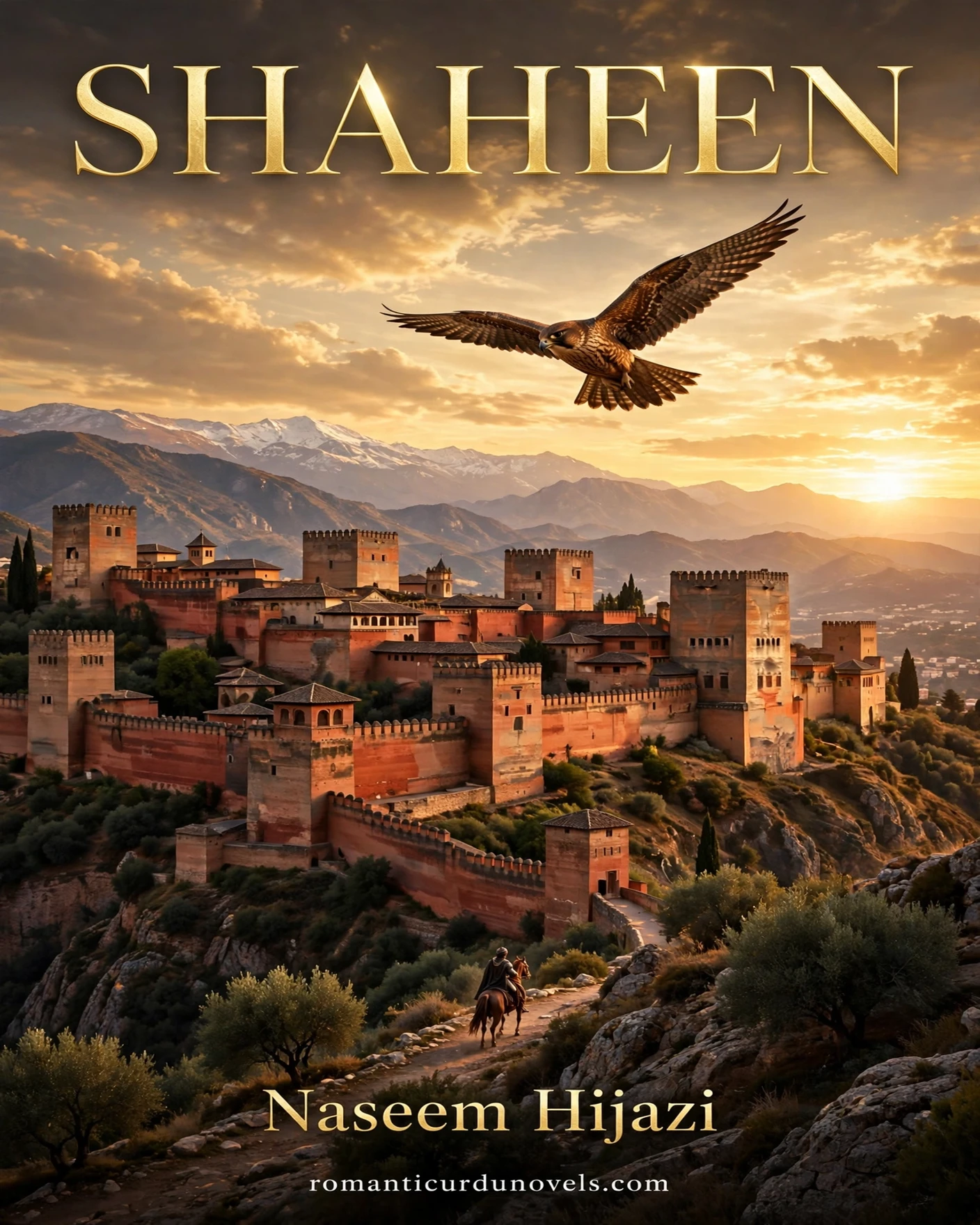
Shaheen by Naseem Hijazi – Complete PDF Download
romanticurdunovels.com
| Novel Details | Information |
|---|---|
| Novel Name | Shaheen – The Falcon |
| Author Name | Naseem Hijazi (Sharif Hussain) |
| Novel Genre | Historical novel, fall of Granada 1492 (not a romance) |
| First Published | 1948, Pakistan |
| Novel Status | ✅ Complete |
| Language | Urdu |
| Availability | Free PDF Download and Read Online |
| English Translation | Badr Bin Mughira, The Shaheen of Andalus |
Shaheen by Naseem Hijazi is one of the great historical novels of Urdu, and this page gives you the complete novel to read online and download as a PDF, together with a full summary, character guide, chapter list, themes and author background that the short download pages never provide.
First published in 1948, it is set in Granada in 1492, in the last days of Muslim rule in Spain.
Its hero is Badar bin Mughaira, a young commander fighting to keep a dying cause alive while his own community divides against itself.
The title tells you the book’s argument before you read a page.
Shaheen means falcon, and the falcon in Hijazi’s writing stands for height, sharp sight, independence and refusal to live low.
It is a novel about people who choose to fly high even when the sky is closing in.
Read this first, because it prevents the most common confusion about this book.
This Shaheen is Naseem Hijazi’s 1948 historical novel about Muslim Spain, and it is a completely different work from Umera Ahmed’s modern novel of the same name.
The two books share nothing but a title: different author, different century, different subject, different characters.
Everything on this page is about Hijazi’s Shaheen, the falcon of Granada, and nothing here describes Umera Ahmed’s Shaheen.
Shaheen Novel by Naseem Hijazi: Complete Story Summary
The novel opens on a community that has already begun to lose.
Granada is the last Muslim state in Spain, and its rulers are divided, its commanders suspicious of each other, and its enemies, Ferdinand of Aragon and Isabella of Castile, patient and united.
Against that background Hijazi places a small mountain territory held by the commander Mughaira, some sixty kilometres long and forty wide, a pocket of Muslim strength in the hills of the Emirate of Granada.
Badar bin Mughaira is Mughaira’s son, and he inherits both his father’s command and his father’s problem.
The problem is not only the armies outside the walls.
It is the traitors inside them, men who sell their honour and their homeland for comfort and safety, and the leaders who have lost sight of their people’s welfare and their own goals.
Hijazi returns to this point again and again, because it is the moral centre of the book: nations, he argues, are destroyed from within before they are conquered from without.
The story follows Badar’s resistance as Granada slides towards 1492.
He fights, he organises, he tries to unite quarrelling commanders, and he carries his forefathers’ legacy.
Beside him stand Musa ibn Abi al-Ghassan, who refuses surrender, and Mansour bin Ahmad, his second in command, and against him stands Abu Dawud, the traitor whose betrayals cost more than any lost battle.
Readers who know Hijazi’s other great Partition novel will recognise the same method here, a fictional hero placed at the centre of real history, and you can compare the two books in our page on
Khaak aur Khoon by Naseem Hijazi.
The novel does not end with a simple victory.
Its power is in the refusal itself: Badar and the few with him choose honour over comfort, even when they can see the end coming.
That is why the book is still read today.
It is not really a book about winning.
It is a book about refusing to surrender one’s soul even in defeat.
The Real History Behind Shaheen: Granada in 1492
To understand Shaheen, you need one date and one place.
The place is Granada, the last Muslim kingdom in Spain, and the date is 1492, the year its rule ended and its people faced expulsion.
For nearly eight centuries Muslims had ruled large parts of Spain, a civilisation famous for learning, architecture and poetry.
By 1492 only Granada remained, and it was surrounded, divided and exhausted.
Hijazi’s history lesson inside the novel is blunt.
He lists the same causes of decline in every summary of the book: rulers ignoring the welfare of their people, moral decay, leaders losing sight of their goals, and above all traitors within who sold the nation’s honour for personal benefit.
This is the author’s interpretation, presented through his characters, and it is worth reading as a novelist’s moral argument about history rather than as a neutral textbook.
Modern historians debate the fall of Granada in more complicated terms, and this page does not present Hijazi’s version as the only account.
Two real historical figures dominate the background.
Ferdinand II of Aragon and Isabella I of Castile, the Catholic monarchs whose joint power pressed on Granada from outside, and Abu Abdullah, the last Muslim ruler of Granada, whose reign ended with the kingdom.
Hijazi also reaches back to the founders of Muslim Spain, Tariq bin Ziyad and Musa bin Nusayr, whose conquests his characters remember as a golden age, and the contrast between that memory and Granada’s present is the novel’s deepest sadness.
If you enjoy novels where history itself is a character, the Partition epic
Aangan by Khadija Mastoor.
One caution about the history in this book.
Hijazi moulded history to fit his plots, and some historians have accused him of distorting facts for dramatic and nationalist effect.
That criticism is part of his reputation, and honest readers should know it.
Read Shaheen for its story, its characters and its moral questions, and read a general history of Granada alongside it if you want the fuller, debated picture.
Main Characters in Shaheen by Naseem Hijazi
Badar bin Mughaira. The central figure of the book, a young military commander and son of Mughaira. He carries his father’s mountain command and his father’s cause, and the novel follows his struggle to unite a divided people and resist the fall of Granada. Translators spell his name Badr bin Mughira, and the English translation is named after him.
Mughaira. Badar’s father, a Muslim military commander who holds a mountainous and forested territory in the Emirate of Granada. His stronghold is the novel’s symbol of the old, self-reliant Muslim Spain, and his legacy is what Badar spends the book trying to honour.
Musa ibn Abi al-Ghassan. A Granada military commander, remembered in history as one of the last defenders who opposed surrender. In the novel he stands beside Badar as proof that resistance was a choice, not a fantasy, even in the final days.
Abu Dawud, the traitor. The novel’s villain and its moral warning. He is the father of Rabia and Angela and the husband of Miriya, and his betrayals show how a cause is sold from the inside. Hijazi gives him a family on purpose: treason here is not abstract, it poisons a household.
Rabia. Wife of Badar bin Mughaira, mentioned in only a few instances in the novel’s summaries, yet important to its shape. Chapters named for her disquiet and her dream show that the fall of a kingdom is also felt at home, in fear, hope and private grief.
Bashir bin Hassan. A physician and companion of Badar. He represents the civilisation behind the sword: learning, healing and loyalty, the things Granada is losing along with its territory.
Mansour bin Ahmad and Naeem bin Rizwan. Mansour is Badar’s adjutant and second in command, and Naeem is a commander in Badar’s army. Together with the high-ranking Granada commander al-Zaighri, they form the small circle of men who keep fighting when larger powers have already given up.
Count Santiago. A fictional character on the other side of the conflict, possibly suggested by the legend of Saint Santiago. He reminds the reader that Hijazi mixes invented figures with real ones, and that the novel is fiction built on history, not history itself.
Chapters of Shaheen by Naseem Hijazi
Shaheen is organised in twelve chapters, and their titles alone map the novel’s arc.
They move from rebellion to renewed resolve, from fathers and sons to the mujahid and the traitor, and they end in black, with Siyah Posh.
Use this list to check that the copy you open is the complete novel and not an abridged or wrongly labelled text.
- Baghi (the rebel)
- Sarhadi Uqaab (the frontier eagle)
- Millat Firoush (nation seller, a traitor)
- In Ka Maizbaan (their host)
- Rabia ka Izteraab (disquiet of Rabia)
- Rabia kay Khuwab ki Tabeer (enunciation of Rabia’s dream)
- Qoum aur us ka Sipahi (Nation and her soldier)
- Naye Azm (renewed resolves)
- Baap aur Beta (father and son)
- Taar-e-Ankaboot (the spider’s web)
- Mujahid aur Ghadaar (the mujahid and the traitor)
- Siyah Posh (the one donned in black)
Themes in Shaheen by Naseem Hijazi
Unity against disunity. The novel’s first lesson is that Granada fell when its people stopped acting as one community. Quarrelling commanders, rival rulers and selfish leaders did more damage than any siege, and Badar’s whole struggle is an attempt to rebuild unity before it is too late.
Treason from within. Abu Dawud is not a footnote. He is the book’s central warning, that the most dangerous enemy of a nation is the insider who trades honour for comfort. Hijazi makes the point through a family, so the reader feels treason as a personal betrayal, not a political slogan.
Faith and perseverance in decline. When defeat looks certain, the novel asks what faith is for. Its answer is that faith is not a promise of victory, but the strength to stand upright in defeat, and that perseverance itself is a kind of victory.
The falcon’s standard. The falcon stands for height, vision and independence. Badar is measured against it throughout: does he look far, does he act freely, does he refuse to live low? The title is not decoration, it is the test every character faces.
Learning from history. Hijazi wrote for readers who, in 1948, were living through Partition and the birth of Pakistan. His message to them, through Granada, was plain: nations that do not learn from their history should be ready to face the same consequences, and this theme is why the novel still finds new readers in every generation.
Glory remembered, glory lost. The book constantly sets Granada’s present against the memory of Tariq bin Ziyad and the early conquests, and against the cultural richness of Al-Andalus. That contrast gives the novel its elegiac tone: it mourns a civilisation, not just a kingdom.
For another novel that treats history as a living argument, rather than a backdrop, see Manto Nama by Saadat Hasan Manto.
Why Is the Novel Called Shaheen? The Falcon Explained
Why a falcon, and why does the title matter so much?
In Urdu and Persian literary tradition the shaheen is the bird that flies highest, hunts alone, and never feeds on carrion.
It is the opposite of the low, the dependent and the bought.
When Hijazi named his hero’s story after the falcon, he was giving his readers a standard to judge every character by, including themselves.
The chapter title Sarhadi Uqaab, the frontier eagle, makes the same point from another angle.
The frontier is where a civilisation is tested, and the eagle, like the falcon, belongs to high, hard places.
Badar’s mountain stronghold is that frontier, and his story is the story of what happens when the frontier is held by a few while the centre rots.
Readers sometimes ask whether the falcon is a real bird in the story.
It is a symbol, not a pet or a plot device, and its power is in what it demands.
A reader who finishes Shaheen and remembers only battles has missed its point.
The falcon asks a question that outlives Granada: when your own world is falling, do you fly high or do you sell low?
Is Shaheen a Romantic Novel? And Which Shaheen Is This?
Let us settle the genre question plainly, because the sites that sell this book often get it wrong.
Shaheen is a historical novel, not a romantic novel, and not a modern love story.
There is a wife, Rabia, and there is family feeling, but the engine of the book is war, politics, betrayal and the fall of a kingdom.
Anyone who opens it expecting a romance will be surprised, and anyone who opens it expecting history will be rewarded.
The second confusion is the one this page exists to end.
Umera Ahmed’s Shaheen is a different, modern novel by a different author, written for a different readership.
It has no Badar bin Mughaira, no Granada, no 1492, and no falcon of Andalus.
Search engines and download sites mix the two books up constantly, because they share a single word, and readers download the wrong book every week.
If the copy you open is set in the present day, it is not Hijazi’s Shaheen, whatever the title on the file says.
A third confusion is worth naming too.
Some download pages describe Shaheen as a story about a guerrilla leader named Abul Hassan, but the novel’s own character list names Badar bin Mughaira as the central figure, and Abu’l-Hasan Ali appears as a Granada ruler, the father of Muhammad XI.
This page follows the novel’s character list and does not repeat the Abul Hassan version as fact, because the sources disagree and the stronger, more detailed source names Badar.
About the Author: Naseem Hijazi
Naseem Hijazi was the pen name of Sharif Hussain, born on 19 May 1914 in Sujaanpur, near Dhariwal, in the Gurdaspur district of Punjab, and died on 2 March 1996.
He was an Urdu novelist and journalist, remembered as a master of Urdu historical fiction.
His method was consistent across his career: take a great turning point of Islamic history, place a fictional hero of strong character at its centre, and tell the history through that hero’s choices.
His Spain novels form a group.
Yusuf bin Tashfin, Shaheen, Kaleesa Aur Aag and Andheri Raat Ke Musafir all deal with the Spanish Reconquista, the long Christian reconquest that ended Muslim rule.
His other books range much wider, from the rise of Islam in Qafla-e-Hijaz and Qaisar-o-Kisra, to the Mongol destruction in Akhari Chattan, to the British conquest of India in Muazzam Ali and Aur Talwar Toot Gayee.
Shaheen sits in the middle of that achievement, and it is one of his most reprinted books, with eight editions listed in reference sources.
Hijazi received the Pride of Performance Award from the President of Pakistan in 1992, and his influence on readers inside and outside Pakistan is undisputed, even by critics who question his history.
That tension is the honest way to describe him: a beloved storyteller, whose romantic, nationalist shaping of history should still be read with open eyes.
For a Hijazi novel from a different century entirely, the Partition story of 1947, see
Woh Jo Qarz Rakhtay Thay by Farhat Ishtiaq.
Who Should Read Shaheen by Naseem Hijazi?
This novel is for readers who love historical fiction with a moral argument, for students of Muslim Spain and the Reconquista, and for anyone who has read Hijazi before and wants his most famous Andalusian book.
It is also for readers who enjoy a hero who stands alone, and for readers who want a serious book about why civilisations fall.
It is not for readers looking for a modern romance, a short book, or a neutral academic history.
It is a long, serious, passionate novel, written in 1948, with the strong colours and clear villains of its time.
Younger or sensitive readers should also know that it is a war novel, with battles, betrayal and the fall of a city, and it should be read as historical fiction, not as a balanced account of 1492.
How to Read Shaheen Online and Download the Complete PDF
Reading the complete novel is simple from this page.
Use the Read Online button to open the full text in your browser, or use the Download PDF button to save the complete novel for offline reading on your phone, tablet or computer.
Both buttons point to the same complete version, so choose whichever suits your reading habit.
Before you settle in, run the two checks that save every Hijazi reader from the wrong download.
First, check the hero: the book you open should follow Badar bin Mughaira in Granada in 1492.
Second, check the author: it should say Naseem Hijazi on the title page.
If either check fails, you have a different book, and you should come back to the buttons on this page.
The version linked from this page is presented as the complete novel, in Urdu, in twelve chapters.
Read it slowly, chapter by chapter, keeping the chapter list above open beside you.
Frequently Asked Questions About Shaheen by Naseem Hijazi
Who wrote Shaheen?
Naseem Hijazi, the pen name of Sharif Hussain (1914 to 1996). It was published in 1948, in Urdu, in Pakistan.
What does Shaheen mean?
Shaheen means falcon. In the novel the falcon stands for height, sharp vision, independence and refusal to live low, and it is the standard every character is judged by.
What is the story of Shaheen by Naseem Hijazi?
Badar bin Mughaira, son of the mountain commander Mughaira, fights to defend Granada and unite its divided commanders in 1492, the last year of Muslim rule in Spain, against Ferdinand and Isabella outside and traitors like Abu Dawud inside.
Is Shaheen by Naseem Hijazi the same as Umera Ahmed’s Shaheen?
No. They are completely different works that share only a title. Hijazi’s Shaheen is a 1948 historical novel about Granada in 1492, while Umera Ahmed’s Shaheen is a modern novel. This page is only about Hijazi’s book.
Is Shaheen a romantic novel?
No. It is a historical novel about war, politics, betrayal and the fall of a kingdom. It contains family feeling, including Badar’s wife Rabia, but romance does not drive the book.
Is Shaheen based on a true story?
It is historical fiction. Granada, 1492, Ferdinand and Isabella, and Abu Abdullah are real, but Badar bin Mughaira is a fictional hero placed at the centre of real events, and Hijazi shaped history to fit his plot.
Who are the main characters in Shaheen?
Badar bin Mughaira, his father Mughaira, Musa ibn Abi al-Ghassan, Mansour bin Ahmad, Bashir bin Hassan, Rabia, and the traitor Abu Dawud, alongside the real rulers Ferdinand II, Isabella I and Abu Abdullah of Granada.
How many chapters does Shaheen have?
Twelve, from Baghi (the rebel) through Qoum aur us ka Sipahi (Nation and her soldier) to Siyah Posh (the one donned in black). The full list with translations is given above.
Is there an English translation of Shaheen?
Yes. It is published in English as Badr Bin Mughira, The Shaheen of Andalus, translated from Hijazi’s Urdu original.
How can I read Shaheen by Naseem Hijazi online or download the PDF?
Use the Read Online and Download PDF buttons on this page. Both point to the complete novel. Check that your copy follows Badar bin Mughaira in Granada in 1492, so you know you have Hijazi’s book and not another author’s Shaheen.
Final Verdict: Should You Read Shaheen by Naseem Hijazi?
Shaheen endures because its question has not aged.
Every generation watches a community divide against itself, and every generation needs a story about the few who refuse to sell out.
Hijazi gave that story a falcon, a mountain stronghold, and a hero who would rather lose honourably than win cheaply.
Read the complete novel online or download the complete PDF using the buttons on this page, and start with the chapter list.
Follow Badar from Baghi to Siyah Posh, and ask yourself at each chapter the question the falcon asks: when the world you love is falling, do you fly high, or do you sell low?