Toba Tek Singh by Saadat Hasan Manto – Complete PDF Download
Toba Tek Singh by Saadat Hasan Manto is the most famous short story ever written about the Partition of India in 1947, and this page gives you the complete story to read online and download as a PDF, together with a theme-level summary, the characters, the themes, the ending explained, and the stage and film history that other download pages leave out
It is only a few pages long
You can finish it in one sitting, yet readers remember it for years, because it asks one question that has no comfortable answer: when a border is drawn through a people, where does a person belong
First, one honest clarification, because it saves confusion later
Toba Tek Singh is not a novel
It is a short story, an afsana, written in Urdu and published in 1955, in the year of Manto’s death
Anyone who promises you a long novel with chapters and a hero and heroine is describing a different book, and this page does not make that mistake
The story is set in a mental asylum in Lahore, two or three years after Partition
The governments of India and Pakistan have decided to exchange their inmates, Muslim inmates in India for Hindu and Sikh inmates in Pakistan, as if human beings were parcels to be swapped
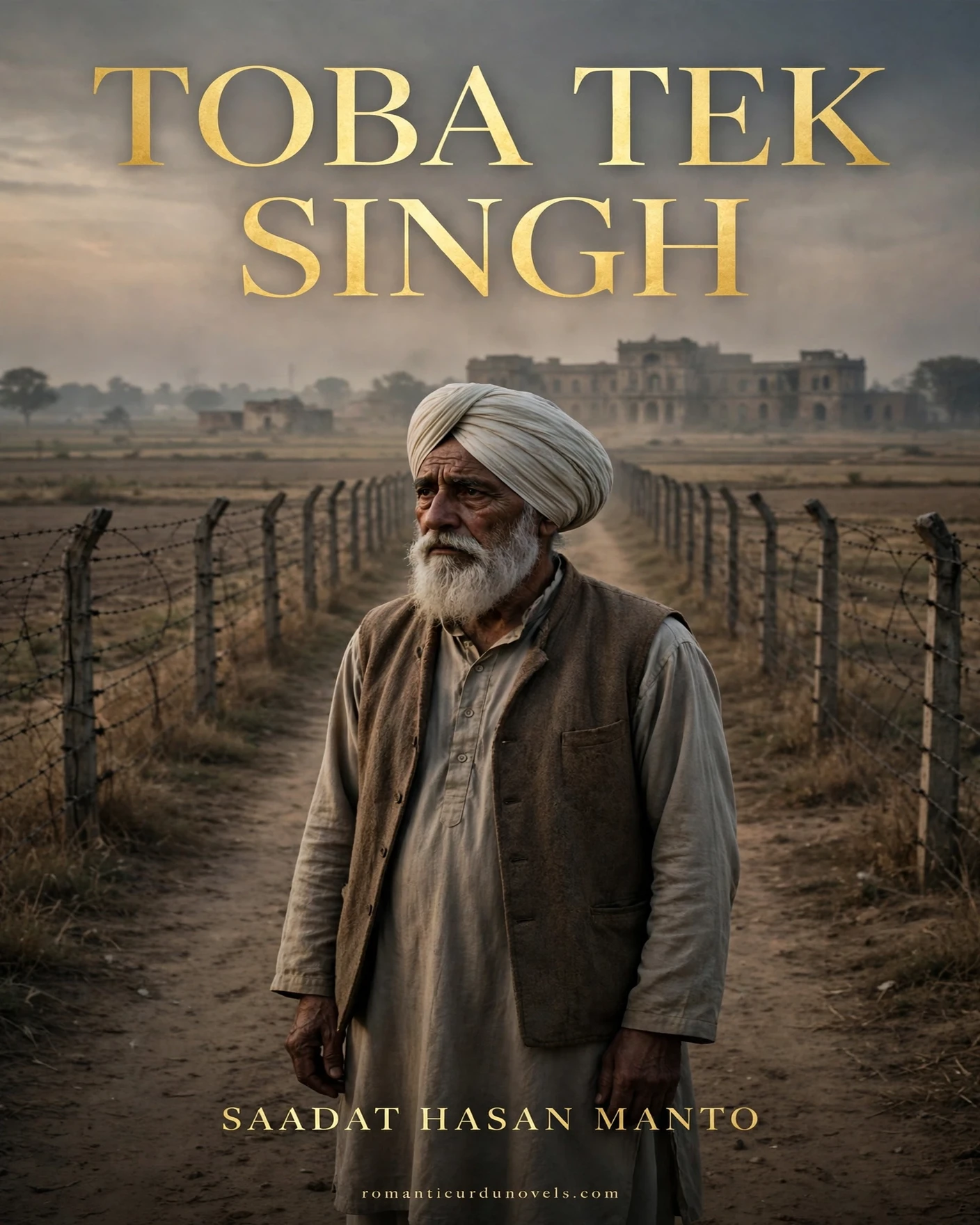
Into that absurd arrangement walks one old Sikh inmate, Bishan Singh, a man everyone calls by the name of his hometown: Toba Tek Singh
His one question, asked again and again, is where Toba Tek Singh is, and nobody in authority can give him an answer that makes sense
romanticurdunovels.com
| Story Name | Toba Tek Singh (Urdu: ٹوبہ ٹیک سنگھ) |
| Author / Writer Name | Saadat Hasan Manto |
| Genre | Satire (Partition short story) |
| Form | Short story (afsana), not a novel |
| First Published | 1955, in the collection Phundne (Lahore) |
| Status | Complete short story |
| Language | Urdu |
| Setting | Lahore asylum and Wagah border, after Partition 1947 |
| Availability | Free PDF Download and Read Online |
| Famous Adaptations | 2005 film, 2006 PTV play, 2018 short film, stage musical |
Read it online or download the complete PDF using the buttons on this page.
Key Facts About Toba Tek Singh
- Form: a short story (afsana), not a novel, and not a book-length work.
- Author: Saadat Hasan Manto (1912 to 1955), one of the greatest short-story writers in Urdu.
- Language: Urdu, with well-known English translations by Frances W. Pritchett and Khalid Hasan.
- Published: 1955, in the collection Phundne (Lahore), one of Manto’s last stories.
- Genre: satire on the Partition of India in 1947.
- Setting: a mental asylum in Lahore, two or three years after Partition, and the Wagah border.
- Central figure: Bishan Singh, a Sikh inmate whom everyone calls Toba Tek Singh.
- Length: a few pages, complete in one sitting, with no chapters and no episodes.
- Fame: named by the BBC in 2018 among the 100 stories that shaped the world.
Toba Tek Singh by Saadat Hasan Manto: What This Story Is
Manto tells this story in a deadpan, factual voice, as if he were reporting events rather than inventing them
The narrator is reliable but not all-knowing, speaking as a Pakistani, seemingly a Lahori, and he never explains the joke
Readers who love short fiction that outlasts its length will recognise the form at once
Like other short masterpieces, this afsana says in a few pages what a long novel sometimes fails to say in hundreds, and a good comparison on this site is the short-story craft of Teri Yaad Khaar-e-Gulaab Hai by Umera Ahmed, a much later Urdu short story that likewise turns on a single image and a single moral question
The Story in Brief: A Theme-Level Summary
Two or three years after Partition, the two new governments agree that lunatics, like other categories of people, should be exchanged
Muslim inmates in India are to be sent to Pakistan, and Hindu and Sikh inmates in Pakistan are to be sent to India
The inmates themselves do not understand the arrangement, and their confusion is the story’s first satirical point
Bishan Singh is introduced as a Sikh inmate who has spent fifteen years in the Lahore asylum
He is a landowner from the town of Toba Tek Singh, and he has not, in all those years, sat down or lain down, a detail every reference summary repeats because it prepares the ending
Fazal Din brings him two pieces of news that cannot both be lived with: his family is safe in India, while the tehsil of Toba Tek Singh now lies inside Pakistan
On the day of the exchange, the inmates are taken under escort toward the Wagah border, and the scene turns chaotic
Some refuse to leave the vehicles, some run in every direction, some fight, and some sing, and the authorities cannot impose order on people who never agreed to the categories imposed on them
Bishan Singh, when his turn comes, refuses to cross to either side
The ending is an image, not an explanation
Bishan Singh lies down on the unnamed strip of ground between the two barbed-wire fences, on land that belongs to neither India nor Pakistan, and the story closes there
Who Is Bishan Singh, the Man Called Toba Tek Singh?
His real name is Bishan Singh, but everyone in the asylum calls him Toba Tek Singh, after his hometown
The narrator alone keeps calling him by his full name, Bishan Singh, and that small distinction carries the story’s central idea
A man and a place share one name, and Partition has put them in different countries, so the question of where the man belongs becomes the question of where the place belongs
In outline, his past is simple, and Manto keeps it simple on purpose
He is a Sikh landowner from Toba Tek Singh with property in the town, a harmless old man who has lived in the asylum for fifteen years
He has nothing to gain from either new nation, and nothing to prove to either, so his single question exposes what the politicians cannot answer
When he is irritated, Bishan Singh bursts into a jumble of Punjabi, Urdu and English that sounds like nonsense
Scholars who have studied the story note that, for all its nonsense, the outburst is pejorative toward both Pakistan and Hindustan alike, cursing both new nations with the same breath
The so-called madman is, in other words, the only character who refuses to flatter either side
His question has no answer inside the new map, and that is the tragedy
His home is in Pakistan, his family is in India, and no border official can tell him where a man in that position is supposed to stand
So in the end he stands, and then lies, precisely where no official can place him: between the fences
The Other Inmates and the Narrator
Manto fills the asylum with brief, sharp figures who work as satire rather than as a cast of characters
One is a Muslim from Chiniot, once a worker of the All-India Muslim League, who announces that he is Quaid-e-Azam and promptly declares war on a Sikh inmate who believes himself to be Master Tara Singh
Another is a man who climbs a tree and sits on a branch, and another is a quiet radio engineer who decides, for reasons of his own, that the situation warrants freedom from sanity
The point of these figures is not to mock mental illness, and readers should not mistake the satire for cruelty
Manto’s target is the sane world that produced Partition, not the vulnerable people locked away from it
The inmates, for all their confusion, treat one another with a rough equality that the politicians outside have abandoned
Themes in Toba Tek Singh by Saadat Hasan Manto
Identity and belonging. Partition sorted people by religion alone, as if faith were the whole of a person
Bishan Singh is sorted as a Sikh and therefore as Indian, yet his land, his town and his life are in Pakistan
The story asks what remains of identity when the one marker a state chooses contradicts everything else a person is
Madness and sanity. The story reverses the usual judgement about who is mad
The inmates ask childlike questions that expose adult absurdity, while the authorities issue orders that no reasonable person could defend
He claims something sharper: that a society capable of Partition has lost the right to call anyone else mad
Satire and the absurd. The exchange itself is the satire, and it needs no jokes added to it
A committee decides that lunatics, like criminals before them, ought to be exchanged, and the decision is carried out with forms, escorts and border posts
Bureaucracy gives absurdity a respectable uniform, and Manto simply describes the uniform accurately
Home. A home is not only a house, and this story proves it by taking a man’s home away without moving him
Toba Tek Singh the town stays where it always was, yet it changes countries, and Bishan Singh the man stays where he always was, yet he changes countries too
Home, in this story, is not a place on a map but a web of family, land and memory, and Partition tears that web while leaving the buildings standing
The Ending Explained: The No-Man’s Land
Readers often ask what the ending means, and the honest answer is that Manto refuses to give it a single meaning
At the simplest level, Bishan Singh will not go to a country that tells him his home is foreign, and will not stay in a country that tells him his family is foreign
The strip between the fences is the only place left that does not lie to him about that contradiction
Is Toba Tek Singh a Novel? The Genre Correction
No, and this correction matters more than it may seem, because most download pages get it wrong
Toba Tek Singh is an afsana, a short story, published in a collection, and it has no chapters, no episodes, and no novel-length plot
It is often sold or listed alongside Manto’s other stories in collections, which is why careless listings call the whole collection, or the story itself, a novel
The Real History Behind Toba Tek Singh: Partition 1947
In 1947, British India was divided into India and Pakistan, and millions of people crossed the new borders in both directions
In Punjab the movement turned violent on a terrible scale, with villages emptied, families separated, and neighbours turned into strangers overnight
That sorting is the real history behind Manto’s satire, and no reader should treat the story as if it floated free of it
Readers who want the other side of Partition literature, the epic rather than the miniature, should read Naseem Hijazi’s Partition novel Khaak aur Khoon by Naseem Hijazi, which follows a family through migration to Pakistan in 1947
The two works make a revealing pair, because Hijazi tells Partition as a long heroic journey with a hero, a family and a cause, while Manto tells it as a short, bitter joke played on powerless men in an asylum
Neither replaces the other, and reading both shows how the same event produced entirely different literatures
One honesty note belongs here, because satire is easily mistaken for reportage
The story presents the exchange of asylum inmates as a government decision carried out with escorts and border posts, and readers should take that premise as Manto’s satirical frame, not as a documentary record of one particular exchange
Its truth is moral rather than archival: it shows what the logic of sorting human beings by religion leads to, when that logic is followed without mercy
About the Author: Saadat Hasan Manto
Saadat Hasan Manto was born on 11 May 1912 in Samrala, in the Ludhiana district of undivided Punjab, into a Kashmiri family
He died on 18 January 1955, in the same year this story was published, after a short, crowded, and fiercely controversial career
In that career he produced twenty-two collections of short stories, a novel, five series of radio plays, three collections of essays, and two collections of personal sketches
Readers who finish this afsana and want more Manto in one place should turn to the collection on this site, Manto Nama by Saadat Hasan Manto, which gathers his stories for readers who want to go beyond a single masterpiece
It is the natural next step, because one Manto story teaches you his voice, but a collection teaches you his range
Three of his Partition stories are grouped by critics as a trilogy, and they make the best reading order after this one
Khol Do, from 1948, and Thanda Gosht, from 1949, face the violence of Partition directly, while Toba Tek Singh, from 1955, faces its absurdity
Manto opposed Partition, and he wrote its human cost without flinching and without taking comfort in slogans
His frankest stories were prosecuted for obscenity in his lifetime, and he defended them in court and in essays, arguing that a society which produces such stories has no right to punish the writer who records them
Toba Tek Singh on Stage and Screen
Few short stories have been adapted as often as this one, and the list itself shows its reach
A film based on a play adaptation of the story was made in 2005 by Afia Nathaniel, and Sarmad Sehbai adapted it for Pakistan Television, where it aired on 3 December 2006
A short film named Toba Tek Singh was released in India in 2018, directed by Ketan Mehta
The stage history is just as rich, and it crosses the very border the story is about
On the sixtieth anniversary of Partition, the Pakistani theatre group Ajoka performed a play adaptation in India, described at the time as a commentary on endless committees, sub-committees and ministerial talks offered as solutions to problems between the two countries
In 2017, Naatak, a theatre group in the United States, staged a grand musical based on the story, with original music and choreography, and the production is available to stream
The wider culture has claimed the story in ways Manto never lived to see
In 2018, the BBC named it among the 100 stories that shaped the world, alongside works by Homer and Virginia Woolf
In the same year, Nandita Das’s biographical film Manto featured it as one of five short stories woven into the author’s life
In 2020, British Pakistani rapper Riz Ahmed released a song titled Toba Tek Singh on his album The Long Goodbye, with further references in his film Mogul Mowgli, carrying Bishan Singh’s name to listeners who may never open an Urdu collection
Who Should Read Toba Tek Singh, and How
This story suits three kinds of reader above all
Students of Urdu literature and Partition history meet it in courses because it teaches satire, symbolism and history in a single short text
New readers of Manto meet it because it is the best possible first Manto: short, complete, and impossible to forget
Readers who want a longer Partition-era panorama after this miniature should turn to Khadija Mastoor’s Aangan by Khadija Mastoor, a full novel of the same decades told from inside a household rather than an asylum
Where Manto compresses Partition into one man’s refusal, Mastoor spreads it across a family, a courtyard, and years of change
The two books complement each other, and reading the novel after the story shows how much of history a short story chooses to leave out
For classic Urdu prose of a different temper, humour and memoir rather than tragedy, the natural next classic on this site is Zarguzasht by Mushtaq Ahmad Yousufi
Yousufi’s wit and Manto’s bite are opposite poles of Urdu prose, and reading both in the same week gives a fairer picture of what Urdu literature can do
One makes you laugh at human folly, the other makes you sit in silence before it, and a complete reader needs both experiences
How should you read it? In one sitting, slowly, and then read the ending twice
The first reading gives you the shock, and the second gives you the structure: the questions that seemed like jokes the first time reveal themselves as arguments the second time
If you read Urdu, read the original, and if you do not, read the Pritchett translation, which is available through Columbia University, or the Khalid Hasan translation, which is widely reprinted
How to Read or Download Toba Tek Singh PDF
Use the buttons on this page to read Toba Tek Singh online or download the complete PDF
The buttons point to the full story file supplied for this page, so you can start reading at once on a phone or a computer, and keep the PDF for offline reading later
Frequently Asked Questions About Toba Tek Singh
Who wrote Toba Tek Singh?
Saadat Hasan Manto wrote it
Born in 1912 in Samrala, he died in January 1955, the year this story was published.
Is Toba Tek Singh a novel or a short story?
It is a short story, an afsana, not a novel
It is a few pages long, with no chapters and no episodes, and it was published in Manto’s 1955 collection Phundne.
What is Toba Tek Singh about?
It is about Partition in 1947, told through Lahore asylum inmates to be exchanged between India and Pakistan
Its central figure, Bishan Singh, refuses to accept that a new border has decided where he belongs.
Who is Bishan Singh?
Bishan Singh is a Sikh inmate of the Lahore asylum, a landowner from Toba Tek Singh, fifteen years in the asylum
Everyone calls him Toba Tek Singh, after his hometown, while the narrator calls him by his full name, Bishan Singh.
Where is Toba Tek Singh, the place?
Toba Tek Singh is a real town and district in Punjab, Pakistan, today
In the story its tehsil lies in Pakistan after Partition while Bishan Singh’s family is in India, so his question has no comfortable answer.
When was Toba Tek Singh published?
1955, in the collection Phundne (Lahore), one of Manto’s last stories
Reference sources agree on 1955, and this page follows them.
What does the ending of Toba Tek Singh mean?
At the exchange, Bishan Singh refuses to cross to either side and lies down on the unnamed strip between the two fences, belonging to neither country
Critics read it as Manto’s verdict on Partition: a place with no name for a man left with no country by a border he did not draw.
Is there a film or play of Toba Tek Singh?
Yes, several
A 2005 film from a play adaptation, a PTV adaptation in 2006, a 2018 short film, Ajoka’s stage play, and a 2017 musical in the United States
The short story itself remains the original and sharpest version.
How can I read or download the complete Toba Tek Singh PDF?
Use the Read Online and Download PDF buttons on this page
They lead to the complete short story file for online or offline PDF reading.
What should I read next by Manto?
Read Khol Do (1948) and Thanda Gosht (1949), the other stories of his Partition trilogy, then explore a wider collection
The Manto Nama collection on this site is a good next step after this afsana.
Is Toba Tek Singh suitable for students?
Yes, for mature school and college readers
It is widely taught because it teaches satire, symbolism and history in a single short text
Younger readers should read it with a teacher or parent, so the ending gets the conversation it deserves.
Final Verdict: Should You Read Toba Tek Singh?
Toba Tek Singh by Saadat Hasan Manto earns its fame honestly, because it does in a few pages what most books about Partition fail to do at any length
It does not lecture, it does not sentimentalise, and it does not offer a solution
It places one harmless old man between two fences and lets the reader feel, in a single image, what it meant for millions of people to be sorted by a border they did not choose
Read the complete short story online or download the complete PDF using the buttons on this page, and read it in one sitting, slowly
Then read the ending twice, and ask yourself the question Bishan Singh asked: where, exactly, is home, when a map has redrawn it?
If you want something contemporary and lighter after Manto’s intensity, a good next read on this site is Dil Se Niklay Hain Jo Lafz by Farhat Ishtiaq, a modern collection that shows how far Urdu short writing has travelled since Manto